Nike Rise Store
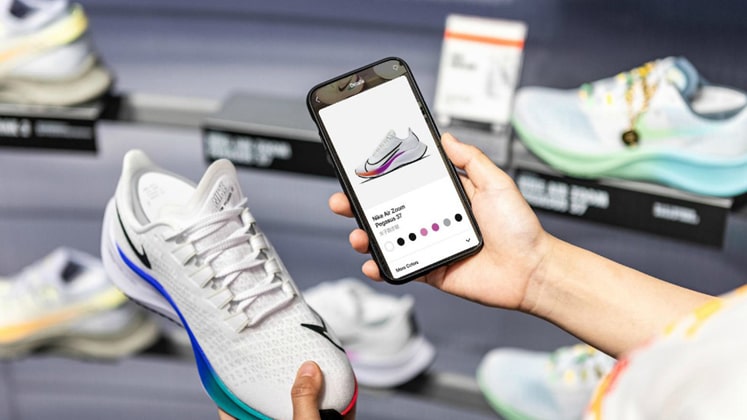
In order to offer a more personalised and up-to-date experience for visitors, Nike opened its first Rise store, in Guangzhou, China, introducing various new retail technologies for its customers.
The store includes a fit service, a tool for the consumers that helps them in finding their best fit footwear in any style. The customers visiting the store can get their fit scanned by a store associate and it tells them the best fit for their feet. Preferred sizes can then be stored in Nike Members’ profiles, potentially speeding up future purchases.
The brand also launched Scan to learn and Scan to try in-app feature that allows shoppers to use their mobiles to alert the staff when they want to try in products or find out more information about a certain individual item.
Burberry enhances shopping inspiration
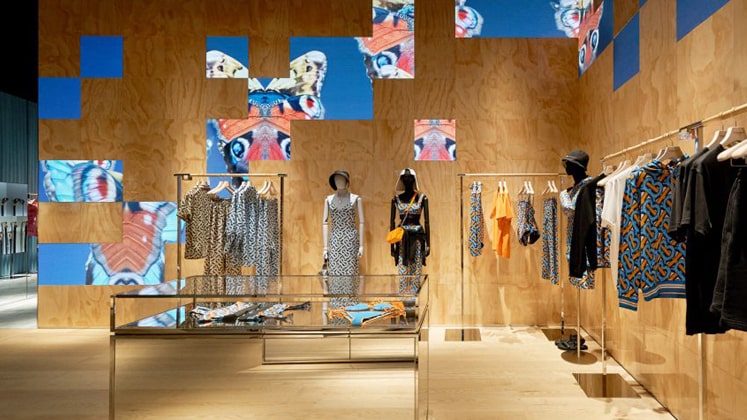
Burberry, the British fashion brand, collaborated with Tencent’s WeChat to create an interactive window display in its store in Shenzhen, China. Together the companies have rolled out a custom mini program that is unlocked via WeChat. The users can create a profile in that app and are given a digital avatar of the cartoon. The shoppers can book three themed fitting rooms, pre-select the clothes and play their own music while they try them on. The app can also be used to book a table at the in-house cafe and make appointments with stylists and other services.
All the products are given a QR code that can be scanned to display more information. Also, the furnishing, fixtures and plinth throughout the store are made from plywood and mirrors. Trial rooms in the store can be booked via app and these rooms are decorated around the concept of Burberry Animal Kingdom, Reflections and the Thomas Burberry Monogram, and visitors can book their favourite ones.
The retailer also recently collaborated with Google on Augment Reality (AR) shopping experience that is activated from mobile web search results. The shoppers searching for Burberry Black TB bag or Arthur Check Sneaker on Google Search would be allowed to click on the image in the result and view the product in 3D overlaid on a real background.
The tool currently available in US and UK will be rolled out globally in the coming future. With this step, the retailer will be able to reach a wider group of consumers than if it was available in a brand app or on the brand’s website. The retailer deployment of the technology on such a scale also suggests that the consumers now understand AR technology enough for it to be more widely available, helping bring in-store shopping experience to more of its customers wherever they are.
Gucci partnership with Snapchat
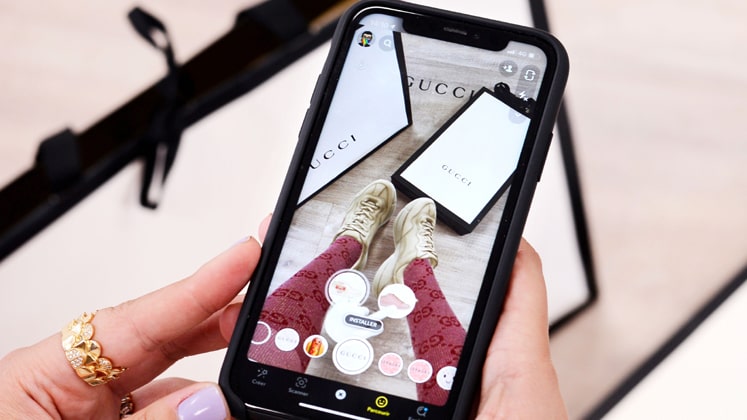
Gucci was probably the first brand to have sponsored a global Snapchat AR lens that lets people virtually try on a pair of shoes before making a purchase. The brand has launched a AR shoe try-on lens that overlays a digital version of its shoes on a smartphone user’s feet and shows a ‘shop now’ button for immediate purchase.
The brand is offering four styles of footwear in two AR lenses, each with two pairs of shoes: Gucci Ace, Gucci Rhyton, Gucci Tennis 1977 and Gucci Screener. The shoppable lenses are available in the US, UK, France, Italy, United Arab Emirates, Saudi Arabia, Australia and Japan, per Snap.
The use of social media platform expands the possibility for the brand to reach out to the maximum number of consumers who can visit a store in regions where shopping malls and department stores remain closed because of the coronavirus pandemic.
Also, product descriptions are considered one of the major aspects for the retailers and the use of such technology helps brand in communicating better with their consumers.
H&M circular fashion technology
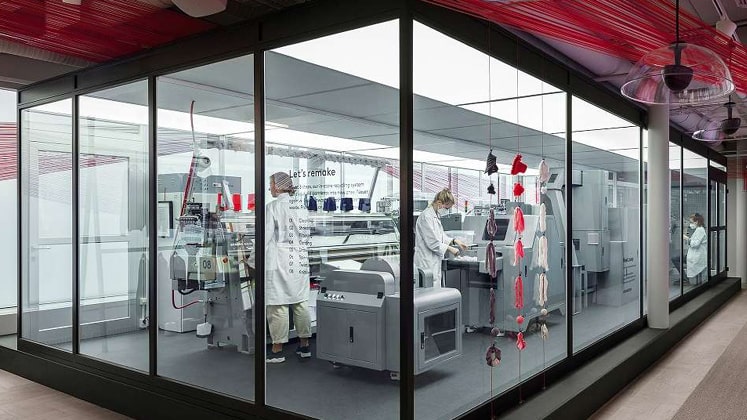
The retailer collaborated with Klarna to enable frictionless and flexible checkout for its US customers across all channels. The members of the H&M loyalty program are allowed to shop now and pay later both on online and in stores using the H&M app. These purchases are handled within the H&M app where customers can decide how and when they want to pay.
The retailer also recently opened Loop for Drottninggatan stores in Stockholm, Sweden that allows the customers to convert their old garments into a new one. Loop uses a technique that dissembles and assembles old garments into new ones. The old garments are cleaned, shredded into fibres and spun into new yarns which are then knitted into new fashion finds. The system eliminates the use of any water and chemical and therefore has significantly lower impact than when producing garments from scratch.
The consumers visiting the stores are also given the opportunity to watch this container-sized machine recycle their old textiles into something new.
Moreover, Monki, the H&M-owned brand also unveiled a new recycling machine named ‘Green Machine’, which it claims to be the first brand to use the new technology to recycle mixed fibres on a large scale.
Developed in collaboration with the non-profit H&M Foundation and the Hong Kong Research Institute of Textile and Apparel (HKRITA) the machine through a hydrothermal process, separates the cotton and polyester blends from one another in a closed cycle. The machine uses heat, water and less than five percent biodegradable chemicals to recycle large quantities of clothing.
The first collection made using the new technology includes a grey hoodie and joggers embroidered with “respect your mother (nature)”. Though the current collection will have smaller quantities, Monki aims to use this type of production process on a larger scale by Autumn 2021.
Robots monitoring social distancing and mask wearing in Japan
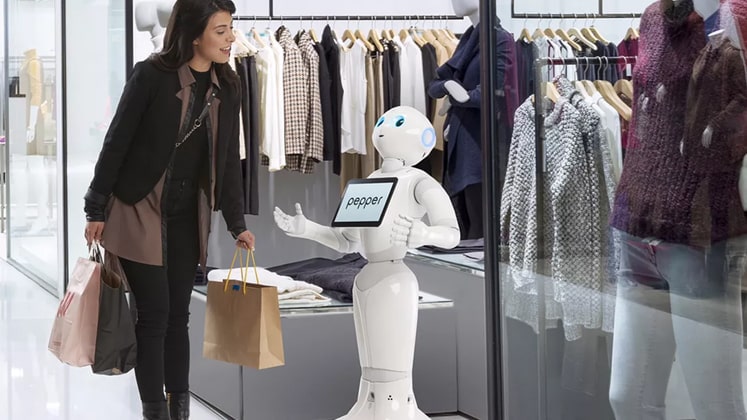
Robovie, developed by Kyoto-based Advanced Telecommunications Research Institute International (ATR), has taken over the job to ensure customers are wearing masks and following social distancing in store in Japan.
It also guides customers around the sales floor at the official store of soccer team Cerezo Osaka. These robots leverage the power of camera and 3D laser beam technology to detect the shoppers that are not wearing masks or are not abiding by social distancing rules.
IKEA launches click and collect for contactless shopping experience

IKEA launched ‘click and collect’ in Hyderabad store giving customers access to household products like work furniture, cooking essentials, children’s furniture or textiles while keeping in mind safety and convenience.
The technology was launched after the lockdown was lifted in India and aimed to ensure minimal contact between co-workers and customers when customers arrive to collect products from the store. Customers can order Ikea products on the company website, pay online and select the ‘click & collect service’ option when checking out. Its delivery team will prepare the order for them to pick up from the ‘click and collect’ station in the store’s car parking area. The store team notifies the customers by text or email to come over to the store and collect their orders.