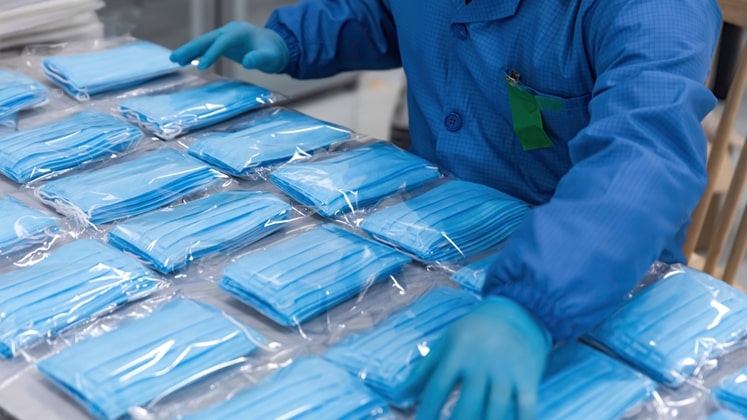
The saga around PPE exports has become like a TV serial with its share of ups and downs, full of drama, suspense, and uncertainty!
The Government initially banned the export of PPE citing domestic requirements as a priority, which is understandable. After a careful assessment of local needs, the Government in early May placed orders for 22.2 million PPE kits, of which around 14.2 million were bought from domestic manufacturers and the rest had to be imported.
Sensing opportunity, almost every garment manufacturer entered the arena, and now, over 1,100 firms in the country manufacture about 7,00,000 to 8,00,000 PPE requirements daily. In fact, the PPE manufacturing industry, in less than 4 months, has become a Rs. 7,000 crore industry in India, the biggest after China.
Once the production of masks and coveralls exceeded the local demand, the Government after much industry persuasion, decided to open the exports of cotton, silk, wool, and knitted masks on 16th May, but other critical items in the PPE category remained closed. Finally, on 29th June, the Government lifted the ban on PPE with quota restriction of monthly export of 50 lakh medical overalls.
But sadly, the move has not given any relief to the exporters, as the requirements to export are very stringent and the BIS certification required takes up to 2 months. Serious questions on quality and testing parameters have also surfaced. In a nutshell, the situation is stalemate between the producers and the Government, resulting in thousands of pieces of PPE suits, manufactured for exports, lying unsold, as rates in local market dropped drastically because of oversupply.
With the size of the global market for PPE projected to be more than US $ 60 billion over the next 5 years, it seems like India has lost the opportunity despite capacities, as competing countries like Bangladesh, Indonesia, and Pakistan are receiving huge orders from large buyers in the US and Europe.
So, while export of fashion masks has been encouraging, the edge that India could have garnered in PPE has been lost. With no future in sight, capacities in PPE segment have been reduced and exporters prefer to get back to their core businesses, many citing PPE production as contingency plan with no long-term prospect!
What has encouraged the exporters to get back to their regular products after the disappointment in PPE is an upward swing in enquirers and import data from traditional markets in June that indicate positivity after months of depression.
While the US registered a monthly surge of 49.81 per cent in June ’20 over May ’20, the Canadian apparel retail market saw 67.50 per cent growth in June ’20 over May ’20. Significantly, India’s exports to the US witnessed a monthly surge of 80.13 per cent over May ’20.
Certain categories in particular are doing well. Brassiere is one of them for the US, growing to 13.86 per cent in June ’20 over May ’20. India grew significantly on M-o-M basis by 234.48 per cent. Another category that has been doing really well is knitted leggings, mostly because it falls under the athleisure category, a preferred segment during the pandemic period.
However, the industry is still far from recovery and there are many ‘ifs’ in the story. Questions that will determine the future are many – how soon will the vaccine be found and made available? Is the fear of resurgence in new COVID-19 infections a reality, and how will the high unemployment rate across the world impact the comeback of sales?