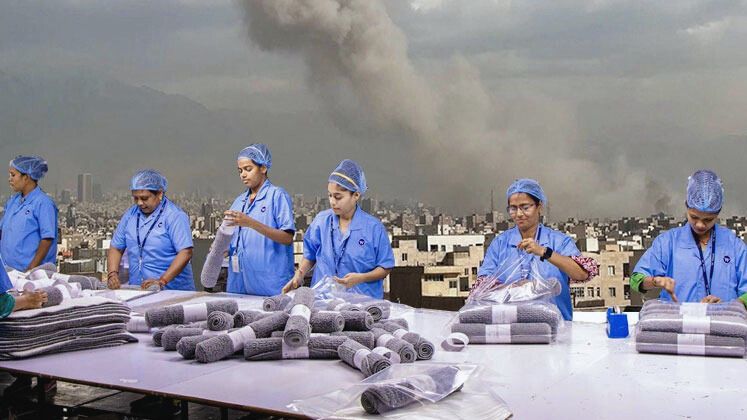
Escalating tensions in the Persian Gulf have heightened concerns over India’s energy security, with potential spillover effects on cost-sensitive sectors such as garments and textiles.
The reason being, the region is home to two critical shipping corridors – one going through the Suez Canal and the other through the Strait of Hormuz.
The Suez Canal is one of the top five busiest global marine routes; nearly 12% of the global trade flows happen through the Suez annually. It reduces travel distance between India’s west coast and Europe, the largest market for India’s apparel exports, by around 15 days and results in significant savings on freight costs.
According to the World Bank, the share of seaborne trade in India’s total foreign trade is 95% by volume and 67% by value. India uses the Suez Canal route for trade with European countries, North Africa and North and South America, which account for more than 35% of the total foreign trade for India. Sectors with higher export dependency, like textiles, on European and North and South American countries could face delay in transit and higher freight cost if the issue persists.
India imports approximately 90% of its crude oil requirements, making it heavily reliant on maritime supply routes. For instance, the Strait of Hormuz accounts for the transit of an estimated 20%–25% of global crude oil supply. Any disruption in the passage could therefore have far-reaching implications for energy-importing economies, including India.
According to Kpler, a global real-time data and analytics provider, India’s recent pivot back towards Middle Eastern crude has increased its near-term exposure to risks linked to the Strait of Hormuz. Kpler assessed that while temporary disruptions could not be ruled out, the probability of a prolonged and complete blockade remained low.
Vessel-tracking data from Kpler indicates that approximately 2.5–2.7 million barrels per day (mbpd) of India’s crude imports currently transit through the Strait of Hormuz, accounting for nearly 50% of the country’s total crude imports. These supplies are largely sourced from Iraq, Saudi Arabia, the United Arab Emirates and Kuwait.
India’s garment and textile exports are particularly vulnerable to disruptions in the Strait of Hormuz. Vessels bound for the US and Europe may now need to take the longer route around the Cape of Good Hope, adding 20–25 days to transit.
Vijay Agarwal, chairman of The Cotton Textile Export Promotion Council, said, “We will face delays in shipments going to Europe and the USA as the shipping routes would now avoid the Gulf region. It is going to hurt us as we are in the fashion business, which is sensitive to season and timing.”
Tirupur, producing over 40% of India’s knitted garments, is navigating tight fashion cycles. Raja M Shanmugham, former president of the Tiruppur Exporters’ Association, said, “The orders for April are at various stages; some have been shipped, while some are being manufactured. And any delay in its delivery has financial implications.” Exporters are also concerned about cash flow disruptions, delayed receivables, and discount pressures on off-season garments.
KM Subramaniam, president of the Tiruppur Exporters’ Association, warned, “Even Dubai is an important transit hub for our business. The closure of the air space in Dubai would cause significant disruption for the export business.”
Crude prices have already strengthened by around 10% since the United States began positioning military assets in the region, reflecting what analysts described as a headline-driven risk premium. Equirus Securities estimated that a disruption to Iran’s 3.3 million barrels per day of production could lift prices by 9–15%, pushing crude from a base of US $ 70 per barrel to approximately US $ 76–81.
Petroleum derivatives also form the backbone of man-made fibres such as polyester, viscose and nylon, which account for a growing share of global apparel consumption. Oil is the primary raw material for polyester yarn, derived from petroleum-based hydrocarbons such as para-xylene. These are processed into purified terephthalic acid (PTA) and ethylene glycol, which are polymerised under high heat to create polyester polymer that is spun into yarn. For one kg of yarn, nearly 85% to 90% of the input is PTA.
India has been seeking to rebalance its fibre mix towards man-made fibres to align with global demand patterns. Any sustained increase in crude prices would raise input costs for synthetic yarn and fabric manufacturers, potentially eroding cost competitiveness. One of the worst-affected segments is likely to be polyester yarn.