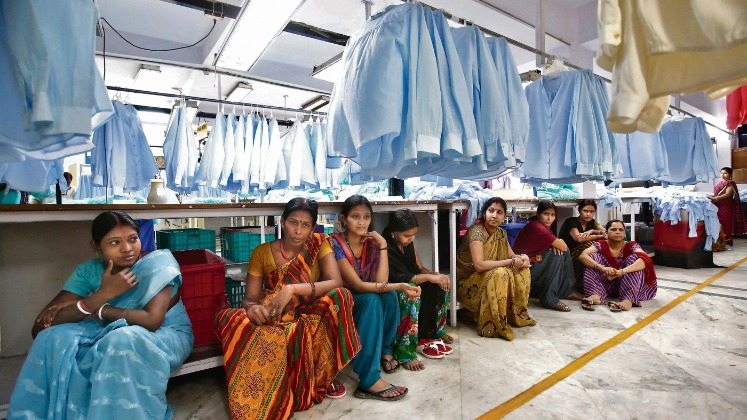
India’s textile industry has warned of a further contraction in export orders of up to 50% in the January–March quarter of 2026, citing the impact of steep US tariffs and deteriorating price competitiveness. The concerns were conveyed to the Parliamentary Standing Committee on Commerce during a meeting held in Coimbatore on Thursday.
Exporters told the committee that they were facing significant challenges, including loss of price competitiveness, supply chain disruptions and reduced order volumes. They also highlighted a shift by American buyers towards alternative sourcing destinations such as Vietnam, Bangladesh and Pakistan, which are not subject to the additional duties imposed on Indian goods. The United States levied an additional 50% tariff on Indian exports on 27th August.
Industry representatives said that the relatively stronger textile and apparel exports recorded in November were largely due to the front-loading of shipments ahead of the Christmas season. They added that exporters had absorbed a portion of the tariff burden to retain buyers and protect market presence, while the depreciation of the Indian rupee against the US dollar had temporarily made exports more price competitive.
The Parliamentary Standing Committee on Commerce is chaired by Rajya Sabha member Dola Sen.
According to a survey conducted by the Confederation of Indian Textile Industry (CITI), around 33% of respondents reported a decline of more than 50% in turnover during the July–September 2025 period compared with April–June 2025. A further 25% reported a similar decline in October–December 2025 compared with the preceding quarter.
CITI said that 65% of respondents believed that the relief measures announced so far by the government had been insufficient. It added that, in the absence of clarity on a resolution to the tariff issue, the industry was expecting a further fall of up to 50% in order books in the January–March 2026 quarter.
The industry body noted that following the imposition of the additional 50% tariff, India was at a competitive disadvantage compared with key rivals such as Vietnam and Bangladesh, which face tariffs of around 20%, and Türkiye, which is subject to a 15% duty. It also reported that exporters were experiencing an extension in credit periods by three to six months, alongside an increase in working capital requirements of more than 30%.
While some exporters have attempted to diversify markets, only about 17% have successfully done so, with a further 43% planning diversification. However, around 70% of those pursuing alternative markets have achieved diversification at levels significantly below expectations.
Exporters told the committee that other markets were unable to replace the US due to fragmented demand and high price sensitivity in Europe and the UK, while markets such as Australia and the UAE were limited to small or niche volumes. They warned that lost US bedding volumes could not be offset elsewhere.
The industry also cautioned that the high tariff levels were likely to severely disrupt India’s home textile exports, particularly in categories such as cotton bed linen, where India accounts for 59.4% of US imports, table linen at 72.9%, and toilet and kitchen linen at 50.5%, segments in which the US remains heavily dependent on Indian suppliers.