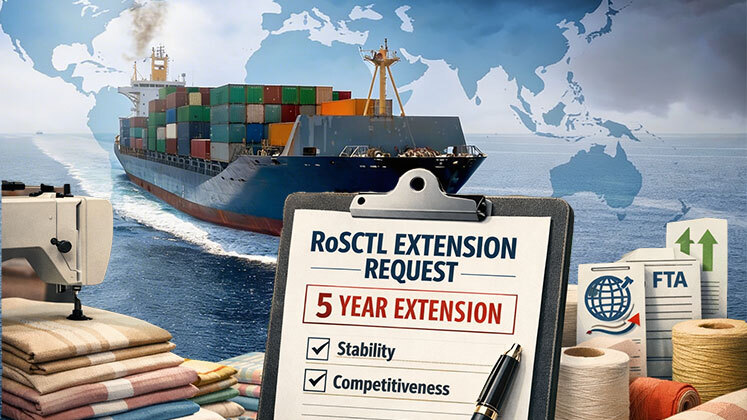
The Home Textile Exporters’ Welfare Association (HEWA) has urged the government to extend the RoSCTL (Rebate of State and Central Taxes and Levies) Scheme by five years, following formal acknowledgement from the Ministry of Textiles that the representation has been taken on record for policy-level examination.
The industry body submitted its representation through the Prime Minister’s Office, emphasising that RoSCTL operates as a World Trade Organization-compliant tax neutralisation mechanism. According to HEWA, the scheme enables the refund of embedded and non-creditable taxes, ensuring Indian textile exporters remain globally competitive.
In an official communication dated 25 February 2026, the Ministry clarified that any continuation or extension of RoSCTL is a policy matter. It noted the observations made by HEWA and stated that the proposal had been placed on record for examination at the appropriate level.
Anant Srivastava, President of HEWA, stated that the association was grateful to the Government of India for negotiating multiple trade agreements that create significant opportunities for textile exporters. He added that to capitalise on these developments, exporters require stability and predictability in domestic policy, describing RoSCTL as playing a vital role in maintaining competitiveness during the current expansion phase.
HEWA underscored the importance of policy continuity as India advances negotiations under the India–EU and India–UK Free Trade Agreements, alongside existing trade arrangements with Australia and the United Arab Emirates. The association maintained that uninterrupted tax neutralisation mechanisms would enable exporters to effectively leverage expanded market access.
The textile and garment sector continues to face global headwinds, including elevated US tariffs, rising sea freight rates, post-pandemic cost escalation and geopolitical disruptions affecting supply chains.
Vikas Singh Chauhan, Director of HEWA, stated that while India is well positioned to benefit from global supply chain realignments, it is not an appropriate time to alter the refund mechanism of embedded taxes under RoSCTL. He emphasised that MSME exporters require policy continuity to sustain employment, strengthen capacity and plan long-term investments.
HEWA expressed confidence that a balanced and forward-looking decision would be taken in the larger national interest, supporting MSME exporters, employment generation and India’s global textile competitiveness.