The Bangladesh Garment Manufacturers and Exporters Association (BGMEA) has identified Uruguay as a potential gateway for expanding Bangladesh’s ready-made garment (RMG) exports into Mercosur, the influential South American trade bloc.
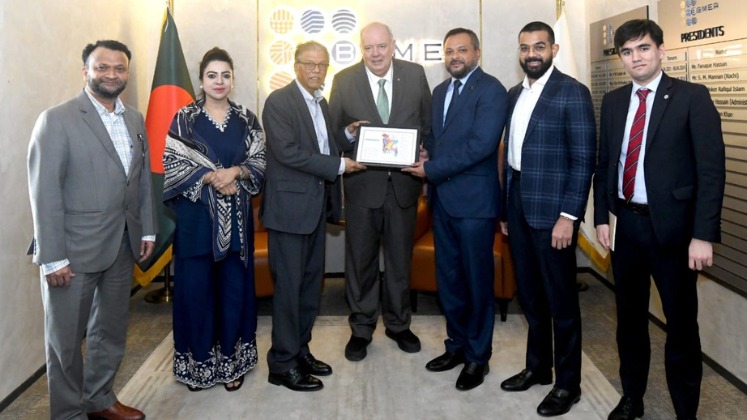
The assessment emerged from a meeting held at the BGMEA complex between the association’s leadership and the Ambassador of Uruguay to Bangladesh, Alberto Guani.
The BGMEA delegation was led by Senior Vice President Inamul Haq Khan and included Directors Shah Rayeed Chowdhury, Sumaiya Islam, and Sheikh Hosen Mohammad Mostafiz. The Honorary Consul of Uruguay in Bangladesh, Mostafa Kamrus Sobhan, was also present.
Discussions centred on strengthening bilateral trade and investment ties, as well as exploring cooperation mechanisms to address challenges arising from Bangladesh’s forthcoming graduation from Least Developed Country (LDC) status.
Inamul Haq Khan outlined the progress of Bangladesh’s apparel industry and sought Uruguay’s support in expanding RMG exports to the country. He noted that despite being the world’s second-largest garment exporter, Bangladesh has yet to secure a significant presence in the Latin American market, a gap the industry is now keen to address.
Shah Rayeed Chowdhury highlighted Uruguay’s strategic geographic position and well-developed logistics infrastructure, describing the country as an effective entry point for Bangladeshi products into the wider Mercosur region.
Ambassador Guani conveyed Uruguay’s interest in increasing apparel imports from Bangladesh and proposed, in return, the export of Uruguay’s internationally recognised traceable wool to Bangladeshi manufacturers.
Elaborating on this proposal, Honorary Consul Mostafa Kamrus Sobhan explained that Uruguayan Merino wool carries global traceability certifications, adding that the use of such high-quality raw materials could help Bangladeshi manufacturers enhance their competitiveness in the premium segment of the global market.
Sheikh Hosen Mohammad Mostafiz stated that importing wool from Uruguay would enable Bangladesh to diversify its product offerings and strengthen its positioning in Latin American markets.
The need for a Free Trade Agreement (FTA) with the Mercosur bloc featured prominently in the discussions, particularly as a means of mitigating the potential trade impacts of post-LDC graduation. Sumaiya Islam suggested that a reciprocal arrangement, under which Bangladesh would import wool from Uruguay while receiving preferential access for finished garments, could be mutually beneficial.
Participants also noted that Uruguay’s efficient ports and advanced transportation systems could serve as a logistical hub for Bangladeshi exporters seeking access to the broader Mercosur market.
Shah Rayeed Chowdhury proposed the dispatch of a high-level trade delegation to Uruguay to gain first-hand insight into market conditions. Ambassador Guani informed the BGMEA leadership that Uruguay had already requested the Bangladeshi Ministry of Foreign Affairs to organise such a delegation and suggested that BGMEA should play a central role in the mission.
The meeting also underscored the importance of simplifying visa procedures to facilitate smoother business travel and communication between the two countries. Both sides concluded by reaffirming their commitment to deepening cooperation and pursuing collaborative growth.