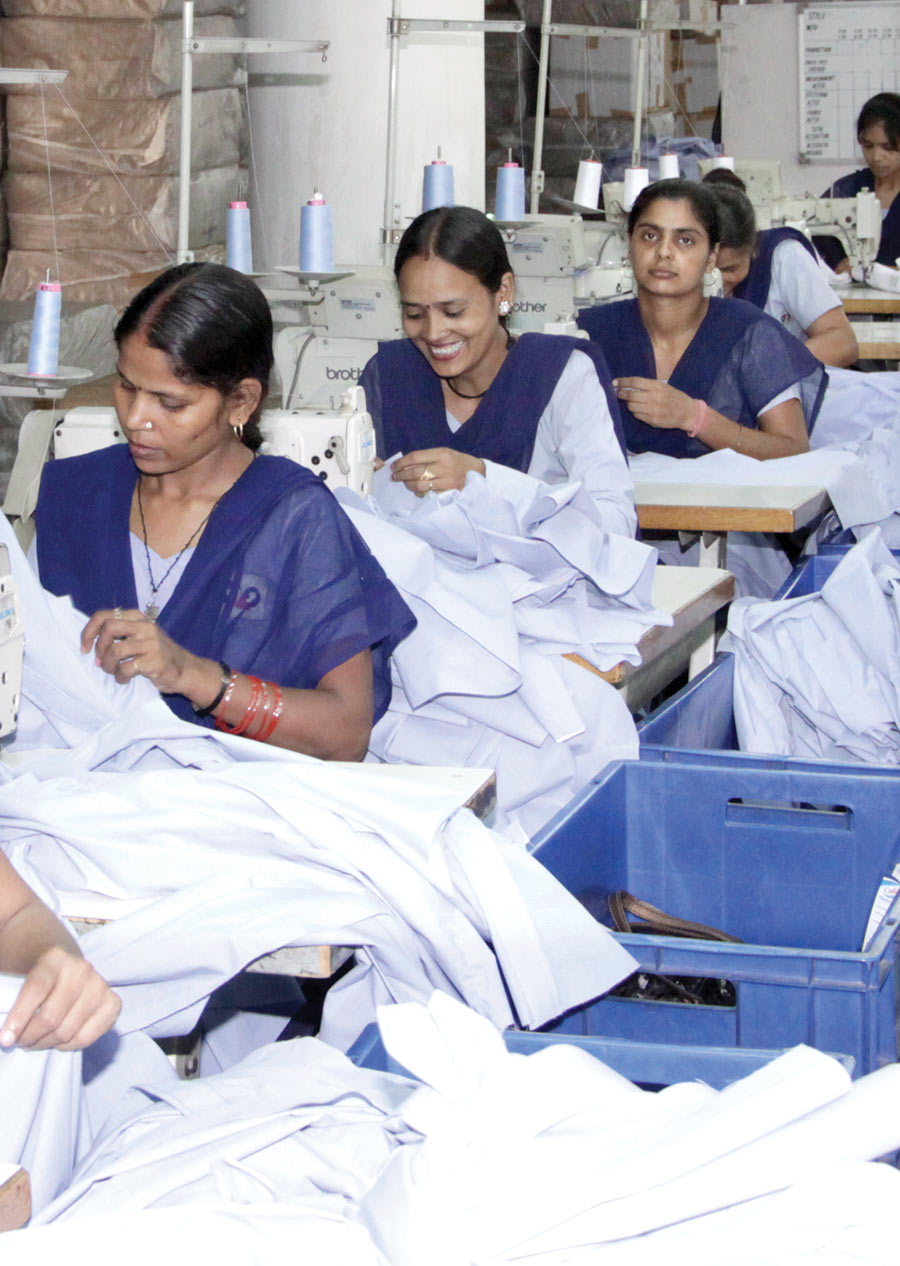
The Indian garment manufacturing sector has added many automation technologies and production systems to attain growth in the organization in the last decade, but now the same can only be achieved through an engaged and motivated workforce. The significance of ‘employee engagement’ was recognized way back by all industry sectors, but lately the garment manufacturing sector has also realized its importance. A StitchWorld-sponsored study by Tusshar Kumar and Neha Shokeen under the guidance of Suruchi Mittar, Associate Professor, NIFT, Delhi found that despite being a people-oriented industry, there is a lack of application of employee engagement practices and very few companies actually have a structured HR policy in place…
According to US-based Consultancy firm Scarlett Surveys, “Employee Engagement is a measurable degree of an employee’s positive or negative emotional attachment to their job, colleagues and the organization which profoundly influences their willingness to learn and perform at work.” It is the resultant of employee motivation, job satisfaction, employee recognition and all other concepts one would find in a book on how to manage employees in return for expectation of growth for the organization.
HR managers at export houses agree that employee engagement is a must today. “Especially in a garment manufacturing export industry, eminence of output and competitive advantage of a company depends on motivated and competent people,” says Samidha Bhatnagar, HR Manager, at Shahi Exports. Reasons Anil Sharma, HR Head, Nahar Spinning Mills Ltd., “When employees are effectively and optimistically engaged with their organization, they form an emotional connection with the organization. This influences their attitude towards the company’s clients, and thereby develops customer satisfaction and service levels”. He further points out that a successful Employee Engagement program helps create a community at the workplace and not just a workforce. The concept of Employee Engagement is simple – a growth achieved through lasting improvements in workplace relationships through building a trust between employees and management.
Need for Employee Engagement
The Indian apparel manufacturing sector has been facing a high attrition monthly rate of 12-23% and employee turnover at various management and non-management levels. This phenomenon has been most prevalent for the operator level of this sector.
The BPO sector was selected for the purpose of studying “Best Practices in Employee Engagement”, not only because of the similarities in terms of the outsourcing modules and people-oriented work but also because of the tremendous growth shown by this sector in terms of the revenue generation and reduction in attrition rate from a high of 37.5% to 18.32% in a matter of just 3 years.
Work pertaining to the affects of engaging employees and its benefits has been undertaken by various consultancies and organizations like the Gallup Organization, Tower-Perrin, and Blessing White, etc. A direct relation has been established between Employee Engagement levels of an organization and revenue generation, employee retention, efficiency, etc. According to employee engagement surveys done by Blessing White in 2010, the difference in engagement levels of India and China is huge with India ahead by a margin of 20%.
The Indian apparel manufacturing sector has been facing high attrition rates and employee turnover at various management and non-management levels. This phenomenon has been most prevalent for the operator level of this sector. Industry experts claim that the monthly attrition rate in the industry is around 12-23% depending upon various factors like nature of work, duration of committed work (seasonal/regular), location of the industry, source of labour (migratory/local), availability of other job options, attitude of management to name a very important ones.
High attrition rate and employee turnover adversely affects the productivity and capacity of the ever growing Indian apparel manufacturing sector. According to S. Kothandapani, Manager HR at SP Apparels, “A greater number of loyal employees ensure low recruitment and training costs, in effect enhancing the productivity of the organization. They are also more willing to put in extra effort when the organization needs it.”
‘Business Process Outsourcing’ Sector: A Comparative Study
The Business Process Outsourcing Sector or commonly called BPO, a highly developed sector in terms of human resource management, has been highlighted not only for undertaking the most engagement initiatives but also for showing tremendous growth in revenue and reduction in employee turnover in the past few years. The monthly attrition rate of the sector has reduced from 37.5% in 2007 to just 18.32% in 2010.
Absenteeism and high attrition rate are not the only similarities between these two people-oriented industries with similar outsourcing modules and deliverables. Even, team leaders and supervisors are similar in designations and work profiles. Since a major portion of the business is being outsourced, therefore the dynamic nature of work demands constant training and re-training of employees. The work done by a sewing operator and a customer care executive is repetitive in nature and requires constant monitoring due to cut-throat deadlines and quality requirements. The work is carried out in shift-time mechanism as the evaluation of an operator is done on the basis of number of pieces made and in the BPOs on number of calls made; both the activities are proportional to time. Job swapping is also a common phenomenon in both the industries mainly to fulfil aspirations of a better salary and future growth.
With such a strong resemblance amongst the two, the BPO sector undoubtedly becomes a suitable choice to study the development of employee engagement practices and policies for the non-management/operator level in the apparel manufacturing sector, but one also needs to keep in mind the disparities among the work force also. One being a service industry and the other being a core manufacturing area, core differences like educational background of the major workforce, career orientation and age wise employee composition would not justify the pay packets and incentives offered by BPOs to be replicated for the apparel industry. Therefore replication of a similar engagement program or practices would not be possible and feasible for the apparel sectors and the only viable and effective solution would be conceptualization and recognition of factors upon which the policies and practices undertaken by the BPO sector could be benchmarked.
Engagement policies undertaken by BPO’ s
Communication being a core aspect of employee engagement, interaction between top level and low level management is crucial for motivation. In many organizations front line managers now carry out activities which are traditionally within the remit of HR such as coaching, performance appraisals, involvement and communication, and discipline and grievances. In most cases frontline HR managers also carry out recruitment and selection in conjunction with HR. In order to handle employee grievances in specific, the BPO sector uses methods such as Employee Satisfaction Surveys or E-sat.
For the development of a healthy and conducive working environment, various activities of team building, games and outings are conducted by BPO organizations. All these practices contribute towards building a healthy and positive work environment.
In the pursuit of maintaining a safe working environment the organizations have safety personals, safety training sessions, and self-defence workshops with mock safety drills. Special emphasis has been paid towards the security of female employees by being extra vigilant at the times of pick-up and drop services.
Facilities and benefits like ample food, cafeteria, cab facility or bus facility have been the highlight of the BPO sector which believes that emphasis should be paid on development of spaces to work in a relaxed environments in the organization premises like lawns etc. providing facilities like extended maternity leaves that are beneficial in retention of female employees.
The major reason for high attrition and low retention in the BPO sector is low career growth opportunities very much similar to the apparel industry. This aspect has been addressed very diligently by the BPO sector. Practices like growth planning, career progression and internal job postings are effective in solving this issue. In the name of retirement schemes, ‘gratuity’ policy is also given to employees, provident fund schemes and medical insurance programs are also precisely followed.
Training and development is an equally significant factor not only in terms of engagement and retention but generally as best HR practices. The identification of the need of training to an employee is the first major task in any organization, which is done with the help of TNA (Training Need Analysis).
Engagement in the Apparel Sector…
The overview of the human resource practices in the apparel manufacturing sector from the perspective of employee engagement is below average compared to other sectors. The only incentive given to an operator working in the garment industry is money which has been the major reason for low retention levels. The apparel sector needs to form a relation of respect, fairness and camaraderie with the employees and emphasize on communication, incentives and facilities.
One of the major findings was the growth of the female workforce in the apparel manufacturing sector and thus highlighting the need for special engagement practices targeted at the retention of the female workforce.
When a region-wise categorization is done of the HR practices the southern part of India is far ahead in terms of engagement and related practices compared to the rest of the country, and the reason could be because the region was first hit by the shortage of labour around year 2005.
During the study it was found that most companies have restructured the Grievances Committee to a Worker’s Committee to cover all the aspects of canteen, food, inter-employee issues and sexual harassment. The most path-breaking measure taken up by the company is the celebration of 4th March as employee safety day, fire fighting training and first aid training sessions.
Even though companies are now initiating globally used practices inspired by other industries, what is still commonly observed is the fact that in a typical export house the top management trained in production or merchandising, or the administration handles all the employee related issues and usually has low experience in terms of managing people effectively. This sector being a people-oriented business requires people who are specifically skilled and experienced at managing human resources. Also, companies which have a personnel department named as HR department, handle only the payroll and incentive-related issues of employees, with the rest being handled by the top management/administration. The personnel department acts just like a representative of the top management to the employees and usually value the employees in terms of money and not the skill he/she possesses.
The apparel industry today needs to change its way and give a serious thought to employee engagement as a mandatory practice in their organization as people today are the key to growth.