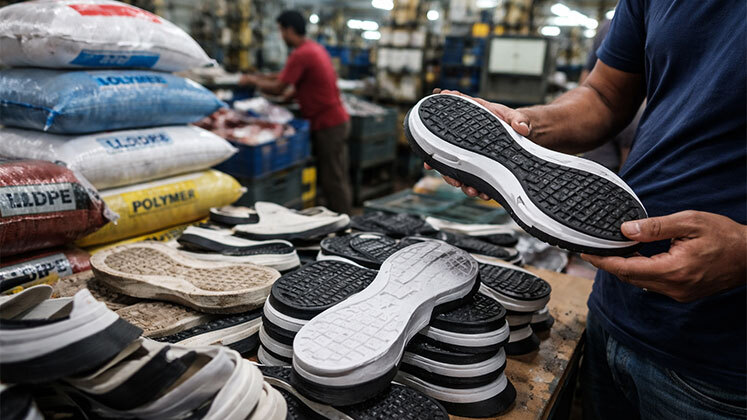
Footwear manufacturers are facing mounting cost pressures and supply chain disruptions as plastic processing units in Kerala scale down operations amid rising raw material costs and capital shortages, impacting the availability of critical inputs such as polymer-based soles.
Industry estimates suggest that 20%–25% of plastic processing units in the state have halted operations due to working capital constraints, according to the Kerala Plastic Manufacturers’ Association. With over 1,000 micro, small and medium-sized enterprises (MSMEs) engaged in plastic processing in Kerala, the disruption is beginning to ripple across sectors, particularly footwear, which is heavily reliant on polymer derivatives.
The situation has been exacerbated by sharp increases in raw material prices. Supply disruptions linked to geopolitical tensions in West Asia, particularly affecting oil shipments through the Strait of Hormuz, have constrained polymer availability. Industry sources indicated that polymer prices have risen nearly 59% within a short span, with multiple price revisions recorded in early March.
Key materials such as LDPE, LLDPE, HDPE, polypropylene, PVC and PET—widely used in footwear soles, components and packaging—have witnessed steep price increases. Plastic processors have reportedly raised prices by up to 50% to offset escalating input costs, directly affecting downstream industries.
The footwear sector, in particular, is experiencing acute pressure. VKC Razak, managing director of VKC Group, stated that existing inventory levels would last only a limited period, after which manufacturers may face production challenges. He indicated that companies may have no option but to increase product prices, as MSME suppliers of raw materials are already under severe financial strain.
Given that most footwear soles are manufactured using polyethylene, the sector’s dependence on polymer supplies has intensified the impact. Razak noted that if current conditions persist, footwear prices could rise by 30%–40%.
The disruption is also extending beyond Kerala, with manufacturers in Karnataka reporting similar supply chain challenges. Companies dependent on lean inventory models are particularly vulnerable, as suppliers struggle to maintain stable pricing amid volatility.
Industry stakeholders are now calling for immediate government intervention, including financial support measures, freight subsidies, and potential reductions in import duties, to stabilise raw material supply and mitigate cost pressures across the value chain.