Stepping into a leadership role within a legacy organisation comes with both clarity and responsibility. With trusted people and established ways of working, the focus can stay on moving ahead thoughtfully, without losing what has been built over time. At the same time, every decision carries the weight of the company’s history. Changes need to be made carefully, with an understanding of what has come before, and progress often means finding the right balance between honouring the past and building for the future.
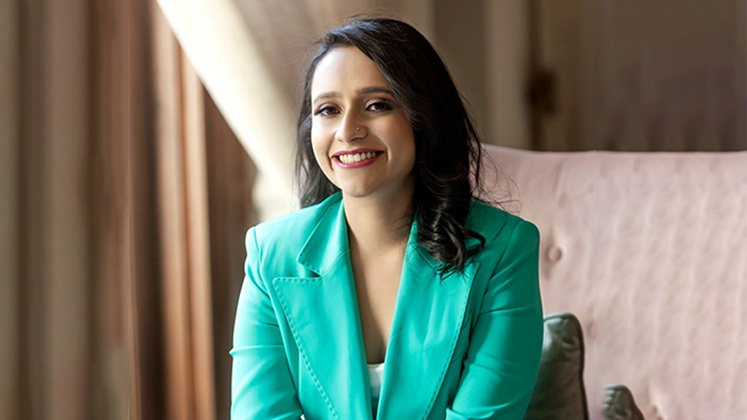
When Sagrika Vir joined Vardhman Textiles in August 2022 as Executive Director, she chose immersion over intervention. Rather than assert authority, she spent her early months listening — understanding how decisions moved through the organisation, where silos existed, and how collaboration could be strengthened. Her focus was not on top-down change, but on enabling teams and improving cross-functional alignment so the organisation could move faster and more cohesively.
The Fabric division, which she now leads, also holds personal significance. Established in 2000 by her mother, Suchita Jain, it has grown steadily into a strategic pillar of Vardhman’s vertically integrated model. Today, fabrics contribute nearly 35% of Vardhman’s ₹9,587 crore (US $1.06 billion) revenue, reflecting both scale and depth.
“I see my role as building bridges — between legacy and new capability, between teams and functions, and between what customers need today and what they will need tomorrow. We don’t want growth at the cost of discipline — we want capability that compounds,” said Sagrika.
She further added, “This approach is driving the division’s move from supplier to strategic partner. That requires technical depth, speed, sustainability, and empathy for the customer’s brand journey, all at once. That’s the direction we are moving in.”
The current phase marks a decisive shift from steady growth to capability-led expansion. Capacity additions across units, entry into synthetics and performance fabrics, deeper customer diversification, and sustainability-led operations are shaping the division’s next chapter.
In conversation with Apparel Resources, Sagrika Vir shares how she is positioning the fabric business for its next leap, with sharper customer focus, technical capability, and long-term competitiveness.
Now that you are fully immersed in the fabric business and your decisions carry real impact, what key goals have you set for it going forward?
Over the past two years, we have laid significant groundwork — in capacity, capability, and customer reach. FY 2025–26 is where that groundwork begins translating into scale.
At the Budhni unit in Madhya Pradesh, a new production line has increased capacity by 20–25%, taking overall fabric processing capacity from 145 lakh metres per month to 200 lakh metres.
We have also entered the synthetic segment, specifically performance fabrics, which is a completely new area for us. Our immediate priority is disciplined utilisation. Expansion only creates value if it is absorbed efficiently. Once we stabilise utilisation levels, we already have future performance fabric phases planned.
But scale alone is not the objective.
The second goal is to increase both the depth and breadth of our customer base. Recent global developments have highlighted the importance of diversification. We want to deepen relationships with existing customers while expanding into new markets and geographies, a strategy we began a few years ago in regions such as Canada and Australia, and which has become even more critical as our capacity has expanded.
Customer centricity today goes beyond delivery and quality metrics.
Each brand has its own design language, aesthetic expectation, and performance requirement. Our engagement has to become more nuanced and customised, not just transactional.
As you build your presence in performance fabrics, where do you see the biggest gaps in India’s ecosystem?
The biggest gap in India, in my view, is the lack of a strong ecosystem. Markets like Taiwan, China, Korea are very advanced in synthetic textiles, because they have a complete system in place…fibres, machinery, dyes, chemicals, and processing, all working together. They operate in clusters, where each unit specialises in what it does best, which ultimately improves quality.
The second gap is innovation, particularly in filaments. There’s a lot happening globally in areas like self-stretch filaments, high-crimp polyester, high-shrinkage yarns, and heat- and water-resistant properties.
The third difference is how closely these markets work with brands. Innovation happens in collaboration, not in isolation. In advanced markets, innovation is co-created with brands. There is long-term trust, shared investment, and joint product development.
Given these gaps in performance fabrics, what are you doing to strengthen India’s ecosystem?
Vardhman’s entry into synthetics has been deliberate and capability-driven.
We defined clearly where we want to play — outerwear and sportswear — because it aligns naturally with our woven strengths and is a fast-growing segment.
Our portfolio now includes polyester, stretch polyester, nylon, stretch nylon, and coated fabrics, significantly increasing technical complexity and value addition.
This segment demands a deeper understanding of fibre behaviour and finishing science — whether it’s water resistance, breathability, or multifunctional coatings. It’s a learning curve, but an exciting one. On raw materials, we’re pragmatic.
Certain high-feature filaments still need to be imported because domestic consistency isn’t yet where we need it. But we’re actively working with Indian suppliers — reviewing SOPs, processes, and controls. Ecosystems are built through partnership, not complaint.
For many brands, speed matters as much as cost. We can deliver runner products in about 20 days and customised developments within 35-40, significantly faster than typical import cycles.
While growing your customer base, is your focus mainly on India, or are you also looking to expand internationally?
Our strategy is balanced — India and exports both matter. Domestic customers contribute roughly 30% of fabric revenues, and we would like to sustain this share with the increased capacity. New-age Indian brands such as Rare Rabbit, are also driving demand for novelty and design innovation.
The US remains a core export market, contributing about 40% of business and providing volume stability. However, recent shifts in trade dynamics have encouraged us to diversify further- Europe, Canada, and Australia are becoming increasingly important diversification markets. In addition to geographic diversification, there is strong headroom for product diversification. For example, if we work with a customer in menswear, we look at possibilities in womenswear or kidswear as well.
We have to have both a hunting approach and a farming approach. Hunt boldly for new customers, and farm and nurture existing customers.

35%Fabrics contribute nearly 35% of Vardhman’s ₹9,587 crore (US $1.06 bn) revenue. |
Across different apparel categories, what kinds of fabric features or innovations are customers asking for today?
Fashion cycles have compressed dramatically. Many brands now treat every week like a new season.
Order quantities are smaller and more frequent. Brands also no longer want to hold large inventories, and want the flexibility to react faster to market trends.
Blended fabrics are in demand such as cotton-Tencel blends that combine comfort with elevated aesthetics. Versatility is another trend. Fabrics that were once used only for women’s wear are now used for both men’s and women’s clothing. Clothing categories are also evolving. It’s no longer just shirts or pants; there is more styling, more variety. New segments such as resort wear, beachwear, longewear have been added.
This makes agility in development and sampling just as important as production scale.
Sustainability is now a must. How are your customers responding, and which aspects of sustainability, such as recyclability, traceability, transparency, or others, matter most to them?
Sustainability is no longer a differentiator, it is a qualification criterion.
Export customers increasingly insist on coal-free processing and renewable energy adoption. Vardhman’s renewable energy share is expected to reach around 60% next year, supported by bio-based boilers and solar hybrid systems.
Water stewardship is another priority, with ZLD systems, salt recovery, and closed-loop dyeing processes already operational in multiple plants.
Traceability is also becoming increasingly important, especially farm-level traceability. However, farm-level traceability in India is complex because farm sizes are small. But digital traceability systems are improving feasibility, and we are investing there.
We are also focusing on textile-to-textile recycling, and I am particularly proud of Renova, Vardhman’s textile-to-textile recycling brand.
It began with pre-consumer waste and now includes post-consumer recycling. The fibre quality we’re achieving today would not have been possible a few years ago. That’s a milestone for us.