Every garment and textile unit in almost every country across every continent has been talking – and making – masks, personal protective equipment (PPE) or medical gowns ever since the pandemic hit the globe early this year. And the US is no different.
With apparel production coming to a standstill over the last few months – owing to coronavirus-induced store closures and lockdowns – and many companies going bankrupt, surviving the storm seems to be the only core focus for all the apparel and textile units in the country. In such a scenario, those who decided to switch to mask/PPE manufacturing are surviving today – with some even faring well.
Yes, cases are still surging in the US, with the numbers, at the time of writing this piece, crossing 5,476,266. However, masks or face coverings are still the most basic precautionary step to combat the crisis. They have not only been instrumental in keeping the deadly coronavirus away, but have also turned out to be a lifeline for many struggling small-time US apparel manufacturers.
When factories closed down and staff had to be furloughed and the economy went for a toss in the country, manufacturing of masks/face coverings was the only way out, and who better than Detroit-based Rosemarine Textiles would understand this! Meghan Navoy, Owner, Rosemarine Textiles, dyes her own fabrics with the lavender and indigo that she grows in her garden. Earlier, she used to churn out masks with the help of leftovers from her other products; however, now she does it by especially tie-dying fabrics for her masks.
She says masks have now become so easily available that people are buying them for style and fashion. She is selling these masks through her own website as well as through Etsy website, and in fact, sales have been so good for her that she has now hired a seamstress to keep pace with mask orders. Importantly, mask orders now account for 40 per cent of Meghan’s mask sales.
Also Read: ‘Mask’ a necessity with a fashion statement
Etsy, which is an American e-commerce website, has had a line of US manufacturers selling masks on its website in the last 3 months. And it’s just growing. Reportedly, Etsy said that in April this year, around 60,000 of its sellers offered masks, thereby generating impressive sales of US $ 133 million. Over the last few months, masks have become one of the biggest categories for Etsy.
Echoing the thoughts of Rosemarine Textiles, the textile maker Airtex Group too considers making of masks and gowns as a long-term business opportunity. The Minneapolis-based unit, which is traditionally a cut-and-sew shop for high-end linen draperies, ventured into manufacturing of masks and non-surgical gowns as the world got hit by the pandemic. While the workers initially made masks by hand, as they do for other products, gradually Airtex invested US $ 500,000 in new technology to make the manufacturing process of masks and gowns more efficient.
What’s the result? Well, the mask and gown-making has shot up – and shot up considerably! The synthetic gowns as well as customised masks are still sewn by hand at Airtex, but masks are mainly manufactured on assembly lines, inaugurated in July 2020.
Noer, President, Airtex Group, says mask market has legs and that’s why the company hasn’t thought twice before investing heavily on it. Notably, Airtex’s yearly sales today range between US $ 20 million and US $ 30 million.
Then there’s Baggu, San Francisco-based reusable bag maker, who too has been leaving a mark lately for its aesthetically designed masks. “Yes, our masks are aesthetic, and since we are known for our colourful patterns, we wanted to offer similar quirky masks,” said Emily Sugihara, Owner, Baggu.
Also Read: Fashion accessories propelling the apparel industry forward in COVID-19 times
The fact of the matter is that more Americans are now getting into mask and PPE making – some because they like it, and many to make money and survive the crisis. But, with so many firms into manufacturing of masks and face coverings, prices have slumped too.
Take, for instance, the American apparel brand Pistol Lake that’s been churning out masks from Oxford cloth at a rapid pace since March 2020, with medical professionals buying them to wear it over medical-grade N95 respirators, so that they last longer. However, with lots of cheaper masks coming from Asia lately, competition has got tougher. Ryan Light, Chief Executive, Pistol Lake, said, “Because we pay our employees more than the minimum wage and we make everything in the US, our products are more expensive and so we are not sure how long we can make these masks.”
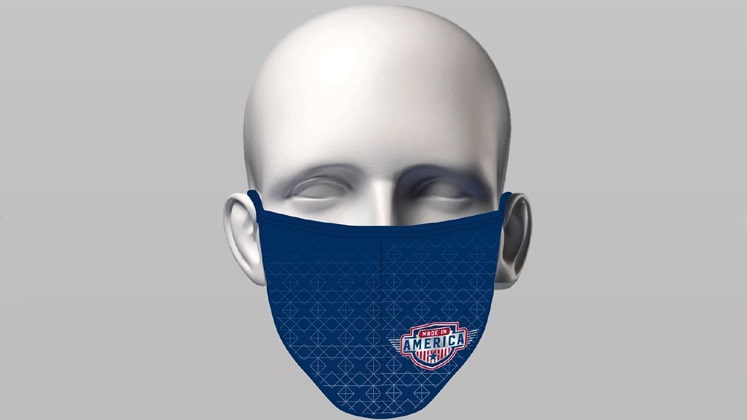
And these ‘Made in America’ masks are environment-friendly as well
Any product that’s eco-friendly is also customer-friendly; even if cost wise, it’s on the higher side. Pistol Lake masks may be expensive, but they are also eco-friendly and that’s what has been their biggest plus point. Substantiating on this further, Ryan said, “Do people still want to pay US $ 15 for an ethically manufactured mask that’s made out of organic and recycled materials or do people see it more like a sock? That’s a debate we have going on internally.”
Yes, price is an issue, but consumers in the US, particularly, have almost always settled for anything that is ethical, and it’s the same even with masks.
Similarly, another US apparel firm Ministry of Supply has been constantly focused on making eco-friendly masks. Few months back, the firm asked one of its manufacturers in the country to shift from sweater making to mask making. The apparel company began donating the viscose and polyester face coverings to hospitals and homeless shelters and gradually started selling them in a buy-one-donate-one deal.
More on this, Aman Advani, Founder and Chief Executive, Ministry of Supply, said “We started selling tens of thousands, and were pretty shocked by it. There was a period when it was the majority of our business.”
Aman says that his factory uses a high-technology machine that knits seamless apparels in single piece. Despite its high cost, Aman has no complaints because his factory hardly wastes any materials, thereby driving his company’s commitment to sustainability. Also, these masks have such a good promotional value that it’s been attracting a lot of shoppers to company’s other products available on the digital platform.
Some innovative and beautiful American masks too are leaving a mark!
Style and fashion sell today, and the rule doesn’t change even for masks and gowns. The Texas-based Shut Your Mouth has designed some beautiful face masks that have a zipper at the mouth enabling it easy for users to eat and drink while practicing all social distancing norms. These zippered face masks come at a price of US $ 34.99, and are available in different fabrics and colours.

Talking of innovation, another American artist Stephanie Hook, known for running e-commerce business, has come out with a Marauder’s Map Face Mask. And how’s this different? From the heat of wearer’s breath, the colour of the mask changes to Marauder’s mask – those familiar with Harry Potter series will know about this better.
Also Read: Can face masks float the boat of the sinking fashion industry?
Then there is LA-based American Giant, which was contacted by the US Government to manufacture masks for medical workers and now that the orders have been fulfilled, they are available on digital platforms as well. These masks are made of 100 per cent cotton, with the addition of copper and silver, making them anti-microbial as well; also, they can be washed up to 15 times. They are priced at US $ 25. Similarly Onzie, priced between US $ 20 and US $ 24, are also getting popular among kids and youth for their fun prints and looks.
Tory Burch face masks, sold in sets of 5 including 1 of each print, too have been talked about a lot for their style, and are priced at US $ 35. Interestingly, it doesn’t make any profit with US $ 5 donated to International Medical Corps and another US $ 5 to Tory Burch Foundation. There are many in the US who are now into making fashionable and beautiful masks, and what’s notable is that there are quite a few who are doing it out of passion and that’s a step to go forward.
Growing demand for medical gowns
At the start of the year, most of the hospitals and chief medical officers in the US were skeptical of getting masks, gowns or other products from China, partially due to trade tensions between both the countries, and there was more demand to have a permanent supply chain in the US.
While substantiating on this more, Ed Gribbin, President, Americas Apparel Producers Network (AAPN), said, “We don’t want to be as dependent on China as we have been in the past, and we want to build a permanent supply chain here.”
That’s why when Ed became the President of AAPN, the group immediately launched a site where suppliers could post their capacity to manufacture critical PPE. Soon, it worked wonders; in just 15 minutes of going live, the website was flooded with posts from 1,000 firms that offered advices and tools.
Interestingly, they were not just apparel firms; everyone, who wanted to reinvent their businesses, came forward to help making PPE. Reportedly, today the requirement for medical and non-medical gowns on a month-to-month (M-o-M) basis is 10 times more than what it was in July 2020. Ed says that FEMA wants 263 million gowns in the next 6 months, while their earlier requirement was 110 million. “I can work with three facilities in California, Cambodia and Colombia to start on that order with 20 million gowns,” added Ed.
Times are changing fast. There is distrust about Chinese products, and there is more liking and support for masks and gowns that are ‘Made in America’. There cannot be a better time than now to promote the movement.
Government extends support
July 2020 saw the Trump Government transfer gown purchasing from FEMA to the Defense Logistics Agency, which is part of the Department of Defense and gives preference to some local products under what’s called the Berry Amendment.
There are also talks in the Congress now, with bipartisan support, to extend the Berry Amendment to include critical medical supplies so that they would have to be sourced in the US. Ed said, “This will not impact hospital systems, but would impact the Federal Government and the way they buy, and possibly the State Governments in buying PPE.”
With the success of the ‘World Mask Week’ that concluded on 14 August and the President Trump also finally wearing mask and encouraging people to wear them, the country seems to be determined to knock out the virus. And this determination will certainly help encourage the movement of ‘Made in America’ face masks and PPE.
It’s just the beginning, and there’s still a lot of road to cover.
Also Read: The future of fashion: Where science meets luxury