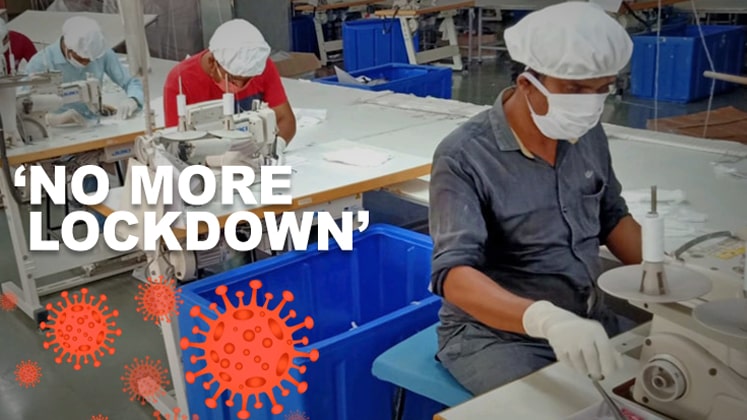
Just after 5-6 months of normal life, India is again facing severe repercussions because of increasing number of Covid positive cases. Now it has overtook Brazil to become the country with the second highest number of Covid cases.
It is a known fact now that Maharashtra has imposed stringent curbs on movement from 13 April to 1 May. The State Government has imposed lockdown-like restrictions in the state with no one,except those engaged in essential services and those exempted, being allowed to move in public places without a valid reason, unless it’s for essential work.
Tirupur and Coimbatore, the leading textile and apparel hubs of Tamil Nadu, are also witnessing sharp spike. Just a few days back, senior State Government officials had a virtual meeting with apparel manufacturers and advised them to be proactive about restricting the spread of the virus. Besides enforcing strict adherence to SOPs, apparel manufacturers were told to encourage eligible staff to get vaccinated.
Gujarat, Ahmedabad and Surat are also not exception. Surat has become the Coronavirus epicentre. One of the factory owners from Gujarat told on the condition of not disclosing his identity that there are several Covid positive cases being founded amongst the workers,which has left the fellow workers in panic.
Similarly, Bengaluru, Delhi-NCR, Punjab and Rajasthan are already struggling with an excessive number of Covid patients and related challenges.
Various State Governments have also imposed night/weekend curfew and have urged people to follow protocols like they did when in complete lockdown.
Nirmala Sitharaman, Union Finance Minister has said that the Government is not going for lockdowns in a big way and will only resort to local containment. “We don’t want to totally arrest the economy…,” she added. It is also worth mentioning here that British brokerage Barclays has said in one of its reports that lockdowns shave US $1.25 billion a week off economy.
These worrisome conditions are also having negative impact on the country’s apparel manufacturers. Many factories have started facing shortage of labour. In discussion with Apparel Resources, apparel manufacturers accepted that their factories are witnessing less number of workers, especially in last 5-6 days.
It is also pertinent to mention here that a big chunk of workers had gone to their villages for Holi festival, but have not yet come back to the factories as workers preferred to stay back safe in their villages rather than coming back to the factories in metro cities where risk is quite higher.
Overall labour shortage is currently at least 10 to 20 per cent in various hubs. Due to this, especially bigger factories, those having good orders, are much worried and due to night/weekend curfew, they can’t expedite the production.
Not only is labour shortage a concern, many apparel exporters are also worried about the conditions in Maharashtra as they send their shipment through Mumbai. They are concerned that if there is any issue in Mumbai, their ready goods will not be dispatched. They had experienced similar negative situation last year also.
Looking at the overall scenario, whatever orders are there at the negotiation stage, garment manufacturers are taking some margin on delivery dates and few of them are even denying such orders which are very much time bound. And the same situation applies to orders of organised retail in domestic market.
Estimating the critical situation, Apparel Export Promotion Council (AEPC)has written letters to various Ministers and urged essential service sector tag for apparel exporters. But Government has not reacted on the same.
Dr. A. Sakthivel, Chairman, AEPC wrote in his letter to the Government, “The industry, which supports over 13 million workers directly and many more indirectly, in rural and backward areas and largely comprises MSMEs, will be severely impacted by the disruption, if the lockdown is again imposed in the factories.”
It is also pertinent to mention here that Bangladesh has also imposed strict nationwide lockdown from 14 to 21 April, but export-oriented industries including apparel manufacturing units will remain open during the same.
All factories have been taking stringent measures and following strict health protocols, as per the MHA guidelines and other advisories. But despite all this, it is a truth that there are reports where dozens of cases are being found in various garment factories and that too in various states.
As far as efforts to keep workers safe and to motivate them to not leave the manufacturing hubs are concerned, apparel manufacturers are taking many steps and the most important is the vaccination of the workers and staff in the factory premises. Many factories have come forward across the country in this regard. Vaccination drives have some positive impact on the workers.
In this entire scenario, it will not be wrong to say that organised factories and especially those which have supported their workers during last year’s lockdown will have least impact. Major impact will be seen on units which have orders but very less workers’ faith in the management.
“Yes, there is fear amongst all be it owners, top level professionals or workers especially as negative sentiments and overall news/information are coming but as majority of factories are doing their best at all levels, it is too early to say about any major negative impact again. Lockdown in many overseas countries and how things have moved there…is also an important factor to be taken into consideration,” said one of the top exporters who doesn’t wish to share his name.