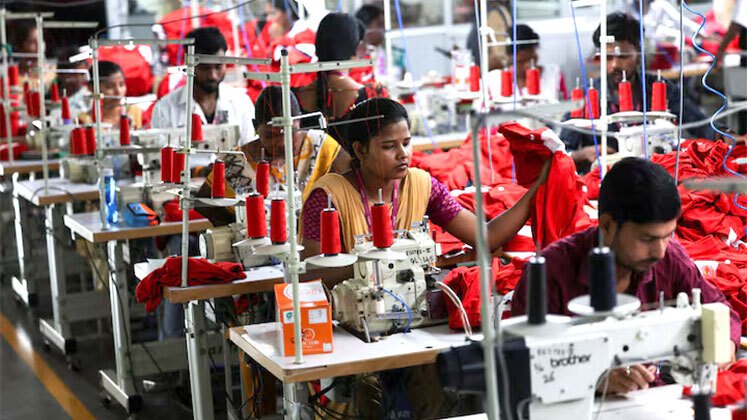
India’s manufacturing sector lost momentum in November, with growth easing to a nine-month low as steep US tariffs weighed heavily on demand, according to a survey released on Monday.
The softer reading casts a shadow over Asia’s third-largest economy, which expanded by a stronger-than-expected 8.2% last quarter, government data showed on Friday. Manufacturing had posted robust gains in the July–September period, but analysts note that the current quarter is likely to show a slowdown as the Trump administration’s punitive tariffs take effect.
The HSBC India Manufacturing Purchasing Managers’ Index (PMI), compiled by S&P Global, fell to 56.6 in November from October’s strong reading of 59.2, slipping below the preliminary estimate of 57.4.
Despite the deceleration, the index remained comfortably above the 50-point mark separating expansion from contraction for the 53rd consecutive month — the longest uninterrupted growth streak since the survey began in March 2005.
The latest slowdown was broad-based. Factory output and total new orders — key indicators of underlying demand — expanded at their weakest pace since February. Survey respondents attributed the trend to challenging market conditions, delayed project starts and intensifying competitive pressures across industry.
Tariffs imposed by Washington were highlighted as a particular headwind. Although the survey did not specify US export data, international new orders rose at their slowest pace in over a year, even as sales continued to grow in markets across Africa, Asia, Europe and the Middle East.
Recent government figures showed India’s trade deficit hitting a record high, with exports to the United States falling nearly 9% year-on-year following the imposition of 50% tariffs on a wide range of Indian imports.
HSBC’s chief India economist, Pranjul Bhandari, said the final November PMI reading confirmed that US tariffs had slowed the manufacturing expansion. She added that business confidence had “fallen sharply” during the month, likely reflecting mounting concerns about the impact of the tariff regime. According to her assessment, the boost from cuts in goods and services tax (GST) appeared to be fading and was unlikely to fully counter the drag from weakening demand.
The survey also showed job creation easing to its slowest pace in 21 months, while the sub-index tracking expectations of future output hit its lowest level since mid-2022 amid growing apprehension over rising competition, including pressure from foreign firms.
Cooling price pressures offered some consolation. Input cost inflation eased to a nine-month low, giving manufacturers scope to limit price rises, and output charges increased at the softest pace since March.
The moderating inflation environment is expected to support a 25-basis-point cut in the Reserve Bank of India’s key repo rate, bringing it down to 5.25% at its meeting later this week.