Interlinings have, for a long time, given garments their shape, strength, style and soul. Today, as apparel manufacturing becomes faster, more automated and sustainability-driven, this once low-profile segment, vital to performancewear and technical textiles, is finally stepping into the spotlight.
India, with its growing talent, scale and market potential, is now at the heart of this shift. For Freudenberg, a global leader in apparel interlinings since 1948, the country has always been central to its growth.
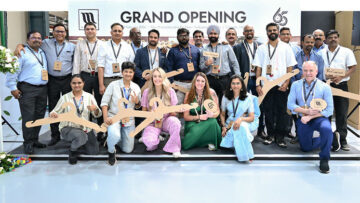
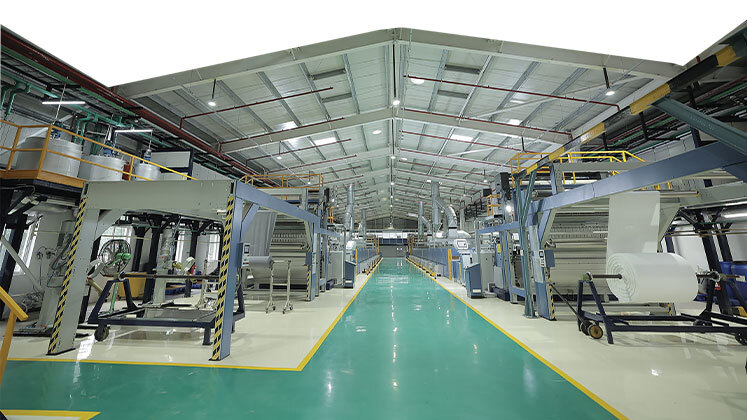
Freudenberg’s recent expansion in Chennai, adding 20,000 square feet of production space and new India-focused production lines, reflects that confidence. This investment is designed to reduce lead times, strengthen local supply chains and deliver world-class interlinings tailored to India’s booming apparel sector, along with the wider South Asian market.
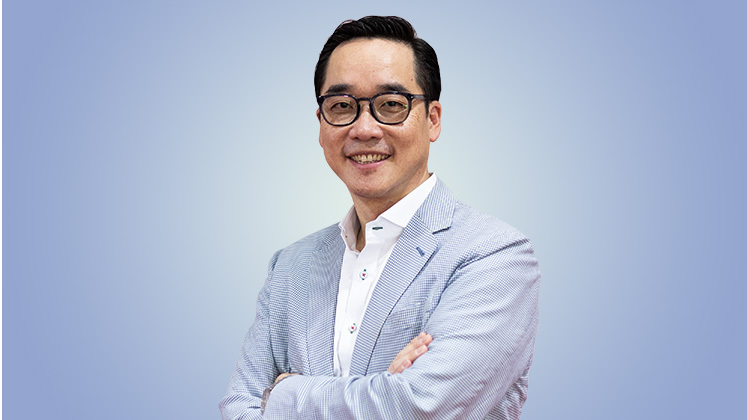
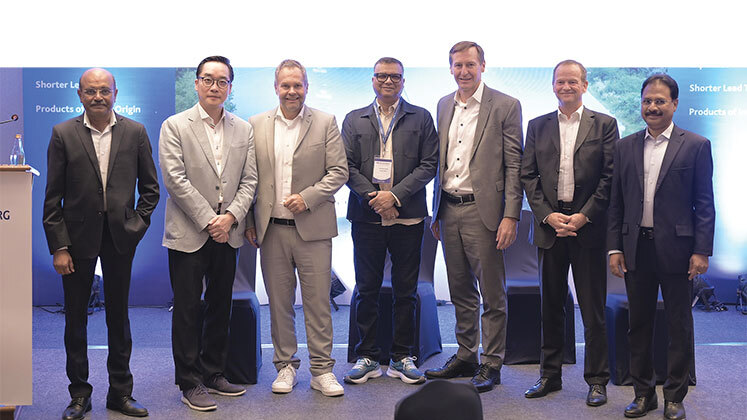
To see the impact of this investment up close, Team Apparel Resources visited Freudenberg’s Chennai plant and met with senior leadership: Dr. Frank Heislitz, Member of the Management Board – Freudenberg Group and CTO; Dr. Andreas Raps, CEO, Freudenberg Performance Materials and Jonathan Oh, Senior Vice President and General Manager, Global Apparel Division, Freudenberg Performance Materials. They shared what is driving this ambitious expansion, how they see India’s apparel market evolving, the role of sustainability in shaping their future growth and how they continue to evolve through innovation and collaboration.
Here are the edited excerpts.
AR: Congrats on the Chennai expansion! It’s clearly a major milestone for Freudenberg in India. How does this boost your global leadership in interlinings and what kind of products will roll out from the new plant?
Jonathan Oh: Thank you. I’d start with the products, because that’s really at the heart of this expansion. Earlier, our portfolio here included non-woven polyester and cotton woven shirt interlinings, along with tapes and die-cuts. Now we’ve added polyester bi-elastic shirt interlinings and polyester woven interlinings for fashion and sports garments. It’s a big step forward in terms of what we can now offer locally. This also helps Indian apparel manufacturers compete faster and more effectively on the global stage while directly catering to nearby markets like Bangladesh and Sri Lanka.
We’ve expanded the facility from 40,000 to 60,000 square feet and introduced new, specialised production lines for 100% cotton and 100% polyester interlinings. The difference this makes to lead times is huge. What used to take six to eight weeks to ship from China can now be made here in just one to two weeks. That’s not only faster but also gives our customers a clear cost advantage, helps them reduce inventory and improves their cash flow.
Expanding our production site, however, is only the beginning for us. We will over the next few years invest more in building our local R&D and technical solution studio capabilities in India. We believe that executing fully our “local for local” strategy is a strategic necessity as India becomes an even more important apparel hub. We want our entire India apparel operations to be self-sufficient. And this includes localizing our famous and popular Shirt Collar Trend Collection which we bring to India now from abroad. In the future, we want to develop here in India the capability to produce the Shirt Collar Trend Collection from concept to design to production. We feel this will make our collection even more valuable to our customers. Our “local for local” strategy will require that we work even more deeply with our domestic brand and export factory customers to understand their needs and develop solutions made specifically for them. At the end of the day, this expansion is about much more than extra space or new machines. It’s a big milestone in our 27-year journey in India’s apparel market and shows how deeply we believe in this market. By localizing interlining production, we’re helping our customers move faster, innovate more and grow stronger. When they succeed, we succeed…and that’s what keeps us motivated every single day.
| “At the end of the day, this expansion is about much more than extra space or new machines. It’s a big milestone in our 27-year journey in India’s apparel market and shows how deeply we believe in this market. By localising interlining production, we’re helping our customers move faster, innovate more and grow stronger. When they succeed, we succeed.” |
AR: What recent innovations in your interlining production are you most excited about and how do you see them changing the game in terms of efficiency, quality or flexibility?
Jonathan Oh: We’ve been making some exciting technological upgrades at our Chennai facility that really move the needle on efficiency, quality and flexibility. For instance, we modified the woven shirt interlining coating process by removing the high-power-consuming infra-red sintering step, cutting energy use in that process by 40%.
We’ve also installed energy-efficient chillers that use only half the energy of conventional units, upgraded all our motors from IE2 to IE3 for better efficiency and replaced lighting with LED bulbs that not only save energy but improve illumination across the plant.
We’ve also added state-of-the-art machinery, including formaldehyde, pH and anti-yellowing testers. This strengthens our in-house quality control and accelerates production processes, ensuring consistent, high-quality output. These new production lines complement the Chennai facility’s existing capabilities such as paste dot, 3P printing and powder dot printing, broadening the range of interlinings that can now be produced locally.
| “We’ve also added state-of-the-art machinery, including formaldehyde, pH and anti-yellowing testers. This strengthens our in-house quality control and accelerates production processes, ensuring consistent, high-quality output.” |
AR: India’s fashion scene is changing fast, from formalwear to activewear. Where are you seeing the strongest demand for interlinings and how is Freudenberg adapting to these new trends?
Jonathan Oh: We’re seeing strong demand for products like polyester bi-elastic interlinings and 100% cotton shirt interlinings. Those continue to do really well. What’s exciting is how diverse the market has become. Fashion in India is evolving fast, and with that comes new styles, new fabrics and different performance expectations. That’s really shaping what manufacturers look for in interlinings.
We work with a wide range of customers, from large global brands to smaller niche factories. What matters to us is providing complete support from design to production, no matter the scale. In fact, the high-end, niche manufacturers are especially excited to collaborate with us because they value premium quality and innovation.
Going forward, a few clear trends stand out. Sustainability remains a big focus, as both brands and consumers want materials that are made responsibly. We’re also seeing a rise in heat-sensitive and delicate fabrics and that’s where our low-temperature fusing interlinings make a real difference. They help save energy while protecting the quality of those fine materials. And of course, the boom in athleisure, sportswear and activewear is driving demand for interlinings that stretch, breathe and last. That’s an area where we’re already quite active, with our bi-elastic and performance-driven solutions.
| “Freudenberg Apparel House of Sustainability is a platform that gives a clear overview of more than 500 products and helps apparel customers easily identify the right sustainable. Dr. Frank Heislitz |
AR: How do you stay in touch with what your customers need and use that feedback to shape new interlining products? Any examples of products that were born or improved through those conversations?
Jonathan Oh: Customer collaboration is at the heart of our product development process. We work closely with designers, product development teams, technical designers and pattern makers to understand their evolving needs, challenges and expectations, especially as they navigate industry trends from concept to production. Through these interactions, we gather valuable insights into material performance, garment construction requirements and sustainability goals. These insights are then translated into targeted innovations that address real-world challenges.
A great example is our 39xx series, a 100% recycled polyester shirt interlining with a cotton-like feel, with no visible impurities or foreign fibre. This product was developed in response to customer demand for a sustainable alternative to traditional cotton interlinings, without compromising on durability, appearance or wash performance.
We also continuously refine existing products based on feedback, whether it’s improving fusing conditions, enhancing stretch recovery for activewear or optimising softness and bulk for premium fashion segments.
Beyond supplying high-quality interlinings, we also guide and support manufacturers in using these materials effectively. Since Freudenberg expanded its business into India’s apparel market in 1998, we’ve developed a strong support network for the textile industry, including technical solution studios in Chennai, Bengaluru and Gurgaon. These studios provide technical consultations, solution services, seminars, trend collections, mockups, interlining recommendation reports and fusing press audits.
AR: Tell us a bit about your House of Sustainability and how it shapes the way you develop new sustainable products.
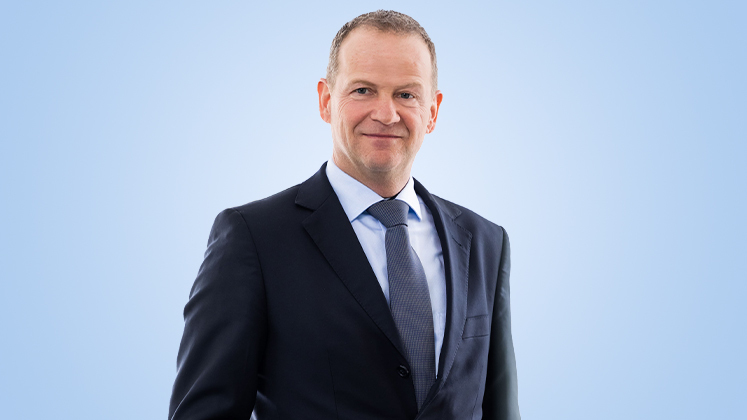
Dr. Frank Heislitz: For us, sustainability isn’t just about reducing our footprint; it’s also about expanding our handprint by helping our customers reach their own sustainability goals. That’s where the Freudenberg Apparel House of Sustainability comes in.
We launched it in 2021 to make sustainability more tangible and transparent. It’s a platform that gives a clear overview of more than 500 products and helps apparel customers easily identify the right sustainable solutions for their needs.
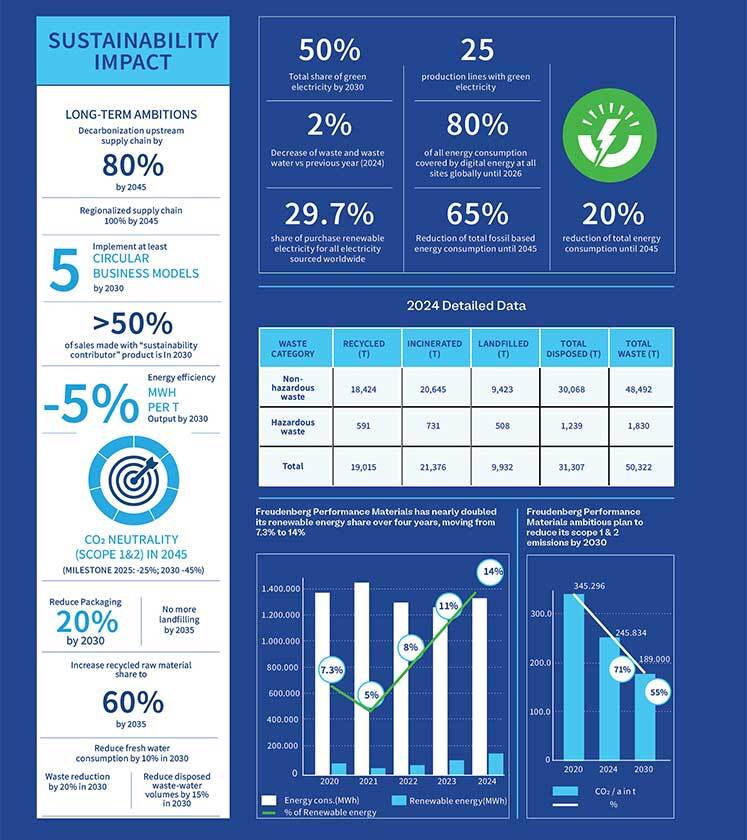
It’s built around four pillars we focus on: certifications and regulations like the Global Recycled Standard, Higg Index, ISO standards and OEKO-TEX®; using sustainable raw materials that are recycled, natural-based or biodegradable; applying smart technologies like energy harvesting, zero liquid discharge and monitoring systems to cut environmental impact; and always looking at ways to reduce our production footprint globally.
These four pillars form the foundation of the seven product groups of our Freudenberg Apparel House of Sustainability: recycled general interlinings, recyclable, energy-saving, biodegradable, sustainable cotton, nature-based and recycled thermal insulations. Each of them give our customers flexible options that meet technical needs while boosting garment sustainability.
Beyond our 39xx series, we’ve developed 100% bio-based, binder-free PLA/wood pulp wetlaid non-wovens. These combine the water absorption and biodegradability of wood pulp with the strength and hot sealability of PLA, all without chemical binders. Unlike conventional PLA non-wovens, which are limited to spunlaid technology and polymer blends, our wetlaid process lets us mix PLA with non-polymeric materials.
The result is a range of high-performing materials that are both technically advanced and eco-friendly. They’re flexible enough for a wide variety of applications. For instance, in packaging, they offer a sustainable alternative to plastics. Other applications of PLA-based wetlaids include embroidery backings, apparel interlinings and healthcare applications such as wound dressings. The mix of natural and technical qualities ensures each application gets the right performance while staying sustainable.
AR: The shift towards sustainability often comes with cost challenges. Do you find that customers value sustainable interlinings enough to pay more for them? How do you tackle the cost-quality balance as a manufacturer?
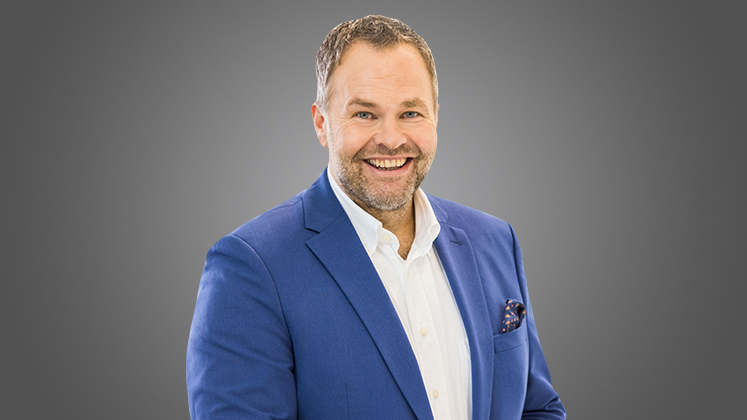
Dr. Andreas Raps: Indeed, sustainable products often come at a higher cost due to the complexity of sourcing responsible materials and maintaining rigorous production standards. However, we never compromise on quality or functionality. Our sustainable products are engineered to meet the same high-performance standards as conventional products. For us, being competitive isn’t just about price, it’s about balancing performance, function and quality. The key is transparency – we want our customers to know exactly what’s involved.
For example, in preparation for the upcoming European Ecodesign for Sustainable Products Regulation (ESPR) and in line with customer expectations, we’ve started rolling out software to calculate Product Carbon Footprints (PCF) as part of our Life Cycle Assessment (LCA) process. This helps us measure the true environmental impact of our products and share that data openly with our partners.
Our Chennai expansion and local investments give us a big advantage. India has a strong network of raw materials and yarns and tapping into that makes us faster, more flexible and more competitive.
This approach also supports frugal innovation, letting products evolve alongside new fabrics, finishes and customer needs. For instance, we produce polyester and HDPE (Highdensity polyethylene) locally for our adhesive systems, which means we don’t have to rely on imports. This improves speed, flexibility and reliability.
Our goal is to scale sustainable innovation in a way that makes it more accessible over time.
Also, sustainability isn’t one-size-fits-all. Different customers focus on different aspects. Some care most about chemical management, others prioritise recycled materials or traceability. That’s why it’s so important for us to stay close to each customer and understand their specific priorities.
I believe that with rising awareness and stronger regulations, the shift towards sustainable materials is only going to accelerate.
AR: With all the talk about rising tariffs and trade barriers, how are things playing out for your India operations? And do you see India turning inward or emerging stronger on the global stage?
Dr. Frank Heislitz: These shifts in global trade dynamics can affect costs and supply chain efficiency, not just in India but across the global apparel ecosystem.
One of Freudenberg’s biggest strengths, though, is our global network. With a diversified sourcing and production base, we can mitigate these impacts and maintain a steady, reliable supply chain for our customers in India and beyond. This global reach gives us the flexibility to adapt quickly to changing trade dynamics without compromising on service or quality.
Looking ahead, we see India becoming even more strategically positioned. The country’s growing domestic market, strong manufacturing base and government initiatives are helping it emerge as a key player in global supply chains. India is increasingly becoming a production hub for major international brands, particularly with new Free Trade Agreements coming into play.
Jonathan Oh: Customers are also looking for flexibility in sourcing and certificates of origin are becoming critical. For instance, I was recently in Mexico, speaking to a garment manufacturer concerned about China-made components. When I explained that we’re expanding production in India and can supply products with an Indian certificate of origin, they were highly interested.
For international brands, having production and expanded capabilities in India and across Southeast Asia gives them options which is exactly what they need in today’s unpredictable world.
Over the next three to five years, our goal is to significantly increase our market share in the country.