Consumers are becoming more demanding day by day and retailers, brands are also on their toes to offer them continuously new styles and new innovative products without keeping much inventories. Many new small and medium-size D2C players are also entering into apparel retail segment; only a few of them have the resources, detailed know-how to invest in design development, team building, raw material sourcing and manufacturing. Interestingly, these players have managed to get the support from the apparel manufacturing companies that has generated all the strengths and abilities to manage the entire process – even for smaller orders – for these new retail players, making it a win-win situation for all.
Eastman Exports Global Clothing, Tirupur is one of the biggest apparel exporters in India. Its division Eastman Brands works on ‘White Label’ concept for the apparel segment, D2D (Design-to-Delivery) and D2C (Direct-to-Consumer). White Label is a concept using which a product or service – produced by one company (the producer) – can be rebranded by the other companies (the marketers) to make it appear as if they (the marketers) had made it.
Anyone who wishes to enter in apparel trade with his label or as a start-up just has to share his vision, design concept or basic information like their thoughts, target customers and requirement. And that label or start-up just has to focus on whatever is his strength. Sizing to tech pack, selection of raw material to manufacturing to the final step of delivery will be taken care of by Eastman Brands.
“We have separate and state-of-the-art infrastructure to support small order quantity like a separate demarked area with 200 stitching machines, variety of printing machines, product development softwares like Clo3D, Optitex. To support our clients, we are also using cloud-based platform. We have got a couple of customers/brands onboard with this model,”says S.Kannan, CEO, Eastman Brands. Eastman Brands uses this infrastructure for its own brand Huetrap and licencee brand 883 Police.
Currently Eastman Brands offers tees, polos, sweats, joggers and shorts and would soon launch shirts, jackets, blazers, trousers, jeans, caps, wallets, socks and sneakers, etc.
AN Associates, another company from Tirupur, is also supporting a similar business model –Pop Station – an initiative by Niket Lulla, CEO of the company, who has diverse experience and global exposure in the apparel trade.
“Our concept Pop Station is a fashion foundry dedicated to nurturing start-ups, brands and private labels through their individual and unique apparel journey,” says Niket who is further adding a direct dispatch facility also.
The company offers an entire range of knitted garments, especially for kidswear, products made from sustainable materials like bamboo, hemp etc., even in small orders! Having 20 to 100+ machines, there are 20+ vendors associated to do manufacturing for AN Associates. Niket selects these vendors on the basis of three major parameters: involvement of owners in business, understanding and interest to cater to online business. “We provide consistent business to our vendors through export and domestic, so they prefer to work with us and do small orders also,” says Niket. He also adds that if a new player or start-up is selling directly (rather than going through an established marketplace and paying commission), there is no major issue of costing, so the manufacturer gets a little more margin to do a small order.
Jaipur-based Desert Crafts is another established manufacturing company, which has a good client base with order quantities growing by the months with prestigious domestic brands, designers as well as renowned overseas clients. Although a sole proprietorship, the firm complies with global norms and is SEDEX 4-Pillar audited.
Swati Shah, Founder of the company and a Fashion Designer, mentions, “We have a variety of clients who order 2,000 -5,000 pieces per style in the organised retail sector. We currently produce around 8,000-10,000 pieces per month. We have a capacity to produce 20,000-25,000 pieces a month, and hence are looking to increase our client base. In the next six months, our plan is to increase our volumes to 40,000-45,000 pieces per month. We specialise in westernwear for women. From casual dresses to jumpsuits to basic tops to flowy maxi dresses, we have made all types of garments for our clients. We work on the brief given by the brands as well as we keep creating styles based on trends to showcase to our clients for orders. Our strength lies in fabric sourcing, trim sourcing, fits and finishes. We believe in getting it right the first time, the efficiency of which our clients appreciate.”
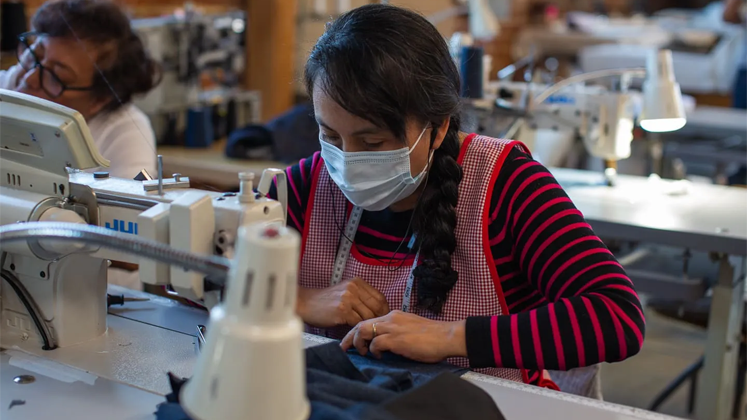
The firm has an MOQ of 200 pieces to start with, yet sometimes works with 20-25 pieces for high-end designer labels. It has a set-up of 100 machines in-house in an area of 10,000 square feet. There are specific teams/operators trained for specific brands, catering to them. They are trained to pay extra attention to the finish and fit of the garment as per the clients’ brief. The workers are paid fair wages well in time.
“Stakes are high as small start-ups have dreams and most of the factories don’t give them a priority. We support them and work on long-term relations and collaborative opportunities. In future, we do have a plan to incubate fashion institutes and support potential emerging players with funding also,” Niket Lulla, CEO, AN Associates
“Over the last year, our client base has increased significantly and so has our business. Currently, overall demand is good in export as well in domestic markets. We are witnessing consistent orders and good payments in the domestic market,” states Swati. The company is also diversifying into making Indian womenswear.
Attraction to do small order quantity
All the above-mentioned companies believe that the growth in this segment is huge for emerging brands as well as suppliers. For new retailers/brands/labels, it is comparatively easy and quick to launch their products as no big product development, lead times and investment are required.
S.Kannan says, “With the growth of e-commerce, this ‘small order quantity’ concept is going to be massive business in next few years and we are trying to make our space to cater to this segment as soon as possible.”
Niket is also of the same opinion as he has witnessed growth of players in this segment. A few of his clients who were used to taking 100 pieces initially, are now placing bulk orders too.
“We entered in this segment as there is enough flexibility regarding product, quick decision in most of the cases as direct owner is involved in the business and not a layer of decision-makers. Payments are also quick (certain advance as rest on delivery) in this segment compared to work with corporates,” he says.
Buyers’ perspective towards small orders is positively changing
Initially, ensuring small orders remains a problem for nearly all the brands and start-ups and for that, they keep on searching for manufacturers/vendors who can support them, work with pretty small factories which are ready to take small quantities. As small factories can’t do much product development for difficult styles, in such cases, factories that are capable of doing such products should be paid a premium. Taking factories into confidence for a long-term relationship and increasing order size over the period are some of the ways by which brands initially manage their small orders.

Established D2C brand Bewakoof.com, and emerging innerwear brand Almo are also good examples of how time-order quantity has increased!
Muskaan Jain, Co-founder, Almo tells Apparel Resources (AR), “We faced challenges during our initial stage as factories normally don’t prefer to work on small orders. We managed by approaching more factories, assuring them that with time, our order size will increase and now we are meeting vendors’ minimum expectation. They are also supporting as they understand our growth potential.”
Product category also matters in case of smaller orders like Bewakoof.com focuses on T-shirts since it is comparatively easy to source and has fewer issues like fit! Working on long-term relations, the brand now has a reasonable size of orders (monthly order size varies from 5,000 pieces in fashion to 1 lakh pieces in core product categories) but still, it works with a few vendors having 50 stitching machines.
Keeping itself updated on manufacturing practices and the latest technology also adds value for such brands and start-ups, and helps to get small orders. This is also a reason that Bewakoof.com’s team often visits apparel technology events.
From first step towards design to delivery, normally most of the companies take time of 30 days for fresh orders.
Small batch orders are being made even for exports!
It is not just small or emerging brands in India which are keen for smaller orders, even globally, many boutique buyers, growing brands and retailers now have a tilt towards small orders. AN Associates also supported two fashion brands in the US on similar lines and has received more enthusiastic response in exports. And this is emerging as an opportunity for many manufacturers who have the flexibility to cater to such orders.
The majority of medium-size vertically integrated companies to apparel manufacturers having 250 machines were previously not ready to do orders less than 1,500 pieces; however, a few companies have started focusing on reduced MOQ now.
“Recently when our buyer/brands were struggling to have low sales due to lockdown, we supported them by even supplying lower than our standard MOQs. So we are flexible enough to do such orders. Our plant is also compatible with small order quantities as well,” mentions Krishna Choudhary, MD, Krishdha Apparel, Faridabad.
Not only Indian, but also Bangladeshi companies are also working in this direction. Welstand Apparel, Dhaka has small orders and the lowest MOQ on its radar. “We are working in small quantities depending on the appetite to pay more by the client. We offer minimum quantity of even 300 pieces per style. We are geared to handle small quantities considering premiums paid to buy the fabrics and custom-made for the prospective clients,” says Faheem, MD of the company. Interestingly the company uses recycled material to make products for ‘Join Life’, a sustainability project of Inditex group.