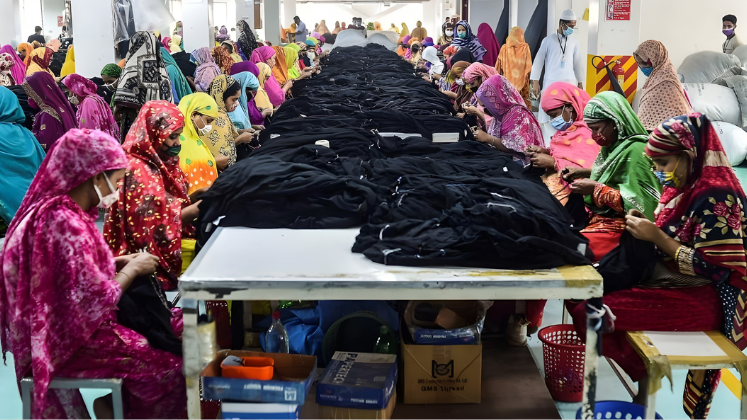
Bangladesh’s garment manufacturers endured a challenging 2025 marked by shifting trade policies, rising domestic costs and operational disruptions, forcing many producers to spend much of the year reassessing short-term decisions rather than executing long-term production strategies.
A major source of uncertainty was the level of duty imposed on exports to the United States, Bangladesh’s largest single-country apparel market. From April, US tariff rates rose sharply before settling in August at levels still higher than previously. By the time relative stability returned, exporters said margins had been eroded and order planning significantly disrupted.
External volatility coincided with mounting domestic pressures. High bank interest rates squeezed working capital, while inconsistent gas and electricity supplies disrupted factory operations. Ongoing trade frictions with India complicated logistics and sourcing, and a fire at Dhaka airport in October destroyed garment samples, imported accessories and raw materials worth millions of dollars. Tighter labour regulations introduced later in the year added further strain.
Compounding these challenges was the approaching graduation of Bangladesh from least developed country (LDC) status in 2026, a move that will remove preferential market access for “Made in Bangladesh” products in several key destinations.
Exporters said 2025 failed to deliver the stability or profitability they had anticipated, despite pockets of shipment growth. Expectations of improvement have largely been pushed to 2026, hinging more on political developments and buyer behaviour than on any immediate easing of structural constraints.
Data from the US Office of Textiles and Apparel show that US apparel imports rose 3.32% year-on-year to US $ 53.01 billion during January–August, while exports from Bangladesh to the US increased 19.82% to US $ 5.64 billion. Figures from the Export Promotion Bureau, compiled by the Bangladesh Garment Manufacturers and Exporters Association (BGMEA), indicate exports to the US of US $ 2.59 billion during July–October, up 5.14% year-on-year and accounting for nearly one-fifth of total garment shipments.
Total exports rose just 0.62% year-on-year to US $ 20.02 billion during July–November. Garment exports increased 1.67% to US $ 35.28 billion in the January–November period, far below the double-digit growth rates once considered routine for the sector.
Export trends to the European Union were mixed. Garment exports to the bloc rose 13.7% year-on-year to €15.26 billion during January–September, according to Eurostat. However, earnings from the EU edged down slightly during the July–November period, despite accounting for nearly half of total garment shipments, according to Mohiuddin Rubel, former BGMEA director and managing director of Bangladesh Apparel Exchange Ltd.
Performance also varied by product segment. Knitwear exports slipped slightly in the early months of the current fiscal year, while woven garments recorded modest growth, pointing to uneven demand and persistent cost pressures rather than a broad-based recovery.
Meanwhile, gas shortages continued to hurt spinning mills, a problem exacerbated by cheaper yarn imports from India. The suspension of transhipment facilities through India in April disrupted logistics, while retaliatory trade restrictions at land ports further slowed cross-border movement. Several large factories that closed after the political transition in 2024 have attempted to reopen but remain entangled in bureaucratic processes.
As 2025 draws to a close, Bangladesh’s garment sector remains on uncertain footing. Industry participants say hopes for stronger performance in 2026 depend on calmer domestic politics, steadier trade relations and a revival in global buyer confidence.