Bangladesh’s readymade garments (RMG) industry recorded average annual productivity growth of 4.19% between 2014 and 2023, driven largely by automation and technological upgrades, according to a recent study by the Bangladesh Institute of Development Studies (BIDS).
The study, titled Technological changes at the process and sub-process level in the RMG industry in Bangladesh, found that jacket production delivered the strongest annual productivity growth at 6.59% over the period. Knit lingerie followed closely with growth of 6.43%, while sweaters (6.05%), home textiles (5.58%) and T-shirts (4.39%) also recorded solid gains.
In contrast, woven shirts, woven trousers and denim posted comparatively lower productivity growth of 3%, 1.15% and 1.81%, respectively, reflecting lower levels of automation in these segments.
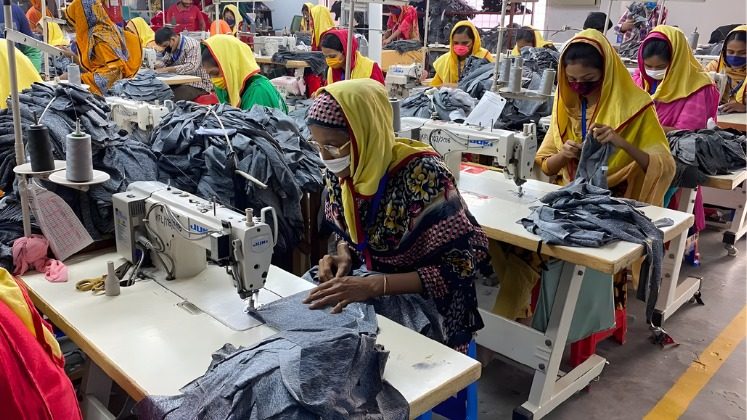
According to the report, automation-intensive processes performed the best over the past decade. Cutting, knitting and wet processing recorded annual productivity increases of 11.13%, 9.85% and 6.11%, respectively. Sewing, which remains the most labour-intensive and least automated stage of production, registered the lowest growth at 3.57%. Weaving and end finishing saw productivity growth of 4.43% and 4.78%, respectively.
The research underscored the continued importance of the RMG sector to Bangladesh’s economy, estimating its contribution at 8.5–10.5% of GDP and 80–85% of total export earnings. The BIDS survey covered 51 garment firms across eight products, 39 processes and 140 sub-processes.
The study highlighted significant efficiency gains over time. In the 1980s and 1990s, 10–12 workers using manual cutting methods could process 4,000–5,000 pieces a day. Today, with fully automated technologies such as CAD, CNC, ERP, RFID and auto spreaders, just two to three operators can cut 8,000–10,000 pieces daily, making the process three to five times faster and more accurate.
In knitting, labour-intensive, low-productivity circular machines have largely been replaced by microprocessor-controlled machines with CAD/CAM integration and digital design capabilities. An operator can now manage eight to ten machines simultaneously, each producing 30–90 kg of fabric per day.
Kazi Zubair Hossain, research associate at BIDS, said the study documented changes in machinery and technology over time across each process. He noted that while the early 2000s marked the beginning of modernisation in the RMG sector, the subsequent two decades have been characterised by increased automation and a stronger focus on sustainability, particularly energy- and water-saving technologies.
The report also found signs of technology convergence between large and medium-sized firms, a trend previously limited to large factories. Technologies such as automated cutting, semi-automatic sewing heads, laser and ozone finishing, auto-dosing in dyeing and digital quality control tools are becoming increasingly common among medium-scale manufacturers.
Inamul Haq Khan, senior vice-president of the Bangladesh Garment Manufacturers and Exporters Association (BGMEA), said manufacturers had invested millions of dollars in automatic cutting and fabric-spreading machines that can be operated through applications to improve efficiency. He added that while large factories could pursue full or semi-automation with support from banks and buyers, small and medium-sized units continue to struggle to access similar support.
BIDS recommended that the government subsidise or incentivise tasks with high potential but low productivity growth, while also anticipating labour displacement resulting from automation. The institute further urged policymakers to support the parallel development of domestic machinery assembly and component manufacturing to gradually build a local textile capital-goods industry.