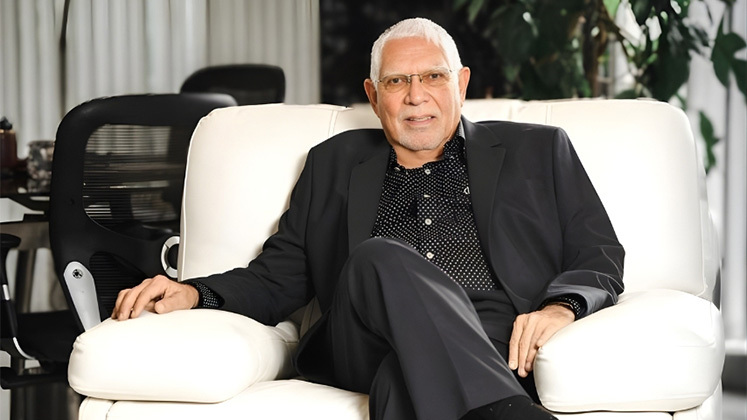
For India to make a bigger mark in the global apparel market, the industry needs more large, well-built companies. Dinesh J Hinduja showed the template of how that can be achieved.
As former Executive Director of Gokaldas Exports, one of India’s largest apparel exporters, Hinduja played a key role in growing the company co-founded by his father, Jamandas H. Hinduja, and his brothers. The company went public in 2005 and today has annual revenues of ₹3,917 crore (US $431 million).
During his time there, he oversaw nearly 52,000 employees across 48 factories. He stepped down in 2011, leaving behind a company that had grown not just in size, but in strength, credibility, and global relevance, helping India establish itself as a trusted player in the global apparel supply chain.
His work was formally recognised with the TFI Lifetime Achievement Award at a ceremony at the Trade Centre, KTPO, Whitefield, Bengaluru.
But the evening was about more than awards. It was about the way he worked, the standards he set, and the kind of leader he was.
Speaking at the awards, Sivaramakrishnan Ganapathi, Vice Chairman and MD, Gokaldas Exports, talked about Hinduja’s constant problem-solving and energy. He said Hinduja mentored quietly, often behind the scenes, and it was an honour to carry forward the work he started.
Whereas Atul Ujagar, Former MD – Sourcing, Indian Subcontinent at Nike, highlighted how Hinduja’s leadership had transformed India’s textile ecosystem, from supply chain innovation to global competitiveness.
Nitin Prasad, Vice President, Walmart Sourcing, pointed out that Hinduja championed modern practices, inclusive employment, and empowered countless artisans and workers.
Echoing these sentiments, Ramanujam Venkat Raghavan, CEO and Director, Shahi Exports, spoke about how Hinduja’s unwavering dedication to workforce development, innovation, and industry collaboration helped shape the global narrative around Indian textiles. In an exclusive conversation with Apparel Resources, Dinesh Hinduja shared his thoughts on the industry today and what the future could look like. Edited excerpts:
After stepping away from the day-to-day of the apparel industry, what are the things you miss most about it, both professionally and personally?
Professionally, what I miss the most is the dynamism. The apparel industry is all about creativity, commerce, and execution. Every season brought a new wave of fashion and a constant push for speed and efficiency. I miss the intensity of taking an idea and turning it into a finished garment at scale. Coordinating across design, sourcing, manufacturing, and logistics teams to meet global standards and deadlines was challenging, but there’s a unique satisfaction in seeing something go from a sketch to store shelves around the world.
I also miss the problem-solving rhythm of the business. Apparel manufacturing is all about balancing cost, quality, compliance, and timelines, often under unpredictable pressures. That fast pace sharpened decision-making and built resilience.
On a personal level, I miss the people and the energy. The factory floors, the design rooms, the merchandising discussions—this industry is deeply human. Thousands of skilled hands, collaborative teams, long-term buyer relationships, and the pride of craftsmanship make it special. Watching teams grow and mentoring future leaders were some of the most fulfilling parts of the journey.
Gokaldas Exports was, in many ways, your life’s work. Seeing it today as a large, professionally run organisation, how do you feel watching the “baby” you nurtured grow into its own? What is the most satisfying part?
Watching Gokaldas Exports grow into a large, professionally managed organisation has been deeply emotional and incredibly satisfying.
In many ways, it really feels like watching a child grow up. When you nurture something from its early days, shaping its values, building its capabilities, facing challenges, and celebrating milestones, you develop a connection that goes beyond business. There were years of hands-on work, tough decisions, market ups and downs, global pressures, and constant reinvention. To see the company now standing strong, expanding globally, attracting top talent, and running with real institutional strength is very gratifying.
What gives me the greatest satisfaction isn’t just the size the company has reached, but the resilience and credibility it now has. The systems, governance standards, customer relationships, and culture of execution that we built over time have matured into a strong foundation. Seeing the company continue to grow responsibly, providing livelihoods to thousands and maintaining its reputation with global brands, is perhaps the most rewarding part.
I’m equally satisfied seeing the leadership transition. A professionally run organisation with empowered teams shows that the company has moved beyond dependence on individuals. That continuity, where the organisation outlives its founders and continues to thrive, is the ultimate proof of long-term stewardship.

Looking back, what was the most challenging phase in building Gokaldas Exports, and why?
One of the toughest phases was during the period when quotas were imposed in 1976, and then working on outerwear, which was outside the quota, while the global sourcing was shifting dramatically. Removal of textile quotas, increasing competition from other manufacturing countries, fluctuating currency, rising compliance standards, and tightening buyer expectations all converged at different points. For a company deeply integrated into global supply chains, these weren’t abstract market forces, they directly impacted order books, margins, and long-term customer relationships.
But in hindsight, those challenging phases were transformative. They strengthened the organisation’s resilience, sharpened its competitiveness, and forced it to deliver.
India has signed key trade agreements with major apparel markets such as the UK, the EU, and the US. What do these developments truly change and what must Indian manufacturers do differently to translate this access into long-term competitiveness?
I think these trade deals are not just a diplomatic victory, they are a structural shift in how Indian exporters compete globally.
First, they make things fairer when it comes to tariffs. For years, we were at a disadvantage compared to countries like Bangladesh or Vietnam. With lower or zero duties, our costs immediately improve.
Second, it pushes us to go beyond just competing on price. Brands want suppliers who are reliable, compliant, and can handle everything from fabrics to finished products. It also supports China+1 sourcing strategies and the need for robust, vertically capable suppliers.
Third, these deals encourage us to grow and invest more. We can expand capacity, upgrade technology, and localise supply chains for fabrics, trims, and other processes. Companies that scale up smartly and early are the ones who really benefit.
For Gokaldas Exports, these pacts help with costs, give us more negotiating power, open new markets, and support highervalue manufacturing. But the real differentiator will always be execution—scaling responsibly, deepening capabilities, and moving up the value chain.
India’s apparel exports are dominated by a few large manufacturers. Does the industry need more globally competitive players to grow exports, and how can this scale be achieved?
Global brands are now looking for suppliers who can handle multilocation production, have financial strength, follow ESG standards at scale, and manage risks well. These are usually traits you find in large, institutional players.
Scaling up in apparel is not just about producing more. It brings real advantages. You get better bargaining power for raw materials. You can invest in automation and technology. You can build stronger compliance systems. You become more resilient to demand fluctuations. You can move into higher-value products. And you get the chance to build long-term brand partnerships. Countries like Vietnam grew their exports this way, with clusters of large, well-funded manufacturers. India needs to do the same and expand that model.
To achieve this scale, three things are really important. First, we need access to patient capital for machinery, working capital for big orders, and investments in ESG and traceability.
Institutional investors and public markets can help professionalise the sector, just like companies such as Gokaldas have done. Second, backward integration and stronger local supply chains are essential for efficiency and reliability. Third, talent and professional management are critical. Scale cannot depend on the founders alone. Strong second-line leadership, good governance, data-driven decisions, and teams who can handle global customers are just as important as the factories themselves.
Looking ahead 10-15 years, what gives you confidence about India’s apparel industry and what, if left unaddressed, concerns you the most?
Global brands are looking beyond China for sourcing, and I think India really stands out. We have a large, skilled workforce, an entrepreneurial manufacturing culture, and democratic stability. At the same time, companies like Gokaldas evolving into professionally run organisations show that the industry itself is maturing. Our young and increasingly skilled workforce gives the country a real long-term advantage, especially in this labour-intensive sector.
What worries me most is that backward integration is still incomplete. We need more depth in man-made fibres, advanced technical textiles, and processing capacity. If we don’t strengthen the broader textile base, India’s apparel competitiveness will always be partly limited. Global buyers today expect shorter lead times, near-season replenishment, and data-integrated supply chains. India needs to get faster at execution, not just increase capacity.