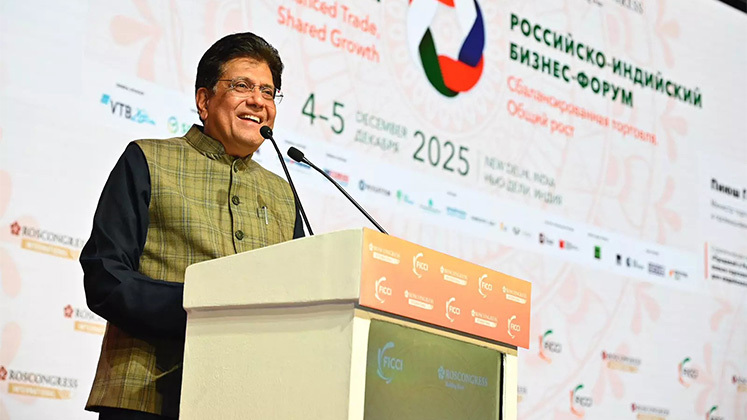
India’s Commerce and Industry Minister Piyush Goyal has said the country’s textile sector is poised to gain substantially from expanding trade links with Russia, as both nations work to unlock untapped export avenues and diversify their commercial engagement.
Speaking at the India–Russia Business Forum in New Delhi, he stated that textiles—along with automobiles, electronics, heavy machinery and food products—represent major growth prospects for Indian exporters at a time when Russia is seeking dependable suppliers.
He reaffirmed the durability of the strategic partnership between the two countries, noting that it has endured despite international uncertainties. He recalled that Prime Minister Narendra Modi had, during his first meeting with President Vladimir Putin in 2014, set an initial bilateral trade target of US $ 30 billion by 2025—an objective that has already been surpassed, with volumes reaching US $ 70 billion. He cautioned, however, that India’s share in Russia’s overall imports remains under 2%, underscoring the need for a more balanced trade structure.
Russian Presidential aide Maxim Oreshkin said bilateral trade could rise beyond US $ 100 billion by 2030, driven by stronger Indian exports in textiles, consumer goods, food and agriculture, pharmaceuticals, telecom, electronics and industrial components. The Forum, held under the theme Sell to Russia, brought together senior ministers, officials and business leaders from both countries to identify opportunities to expand Indian shipments and narrow the trade gap, according to the Ministry of Commerce & Industry.
Goyal said India offers a broad portfolio of products that align with Russia’s industrial and consumer requirements. He argued that textiles are especially well-placed due to competitive manufacturing capabilities, a sizeable skilled workforce and global confidence in Indian quality standards. He also pointed to India’s resilient entrepreneurial and start-up ecosystem, strong STEM talent pool, and improvements in logistics and compliance systems as factors bolstering export competitiveness.
India’s macroeconomic strength—reflected in GDP growth of 7.8% in the first quarter and 8.2% in the second, alongside inflation of just 0.25% last month—has created a stable foundation for long-term trade expansion. He added that India’s young and skilled workforce could help Russia mitigate its projected shortage of three million professionals.
Both sides reiterated their commitment to deepening the ‘Special and Privileged Strategic Partnership’, raising bilateral trade above US $ 100 billion by 2030, enhancing Indian exports, expanding cooperation in services and innovation, and turning closer collaboration into shared economic gains.