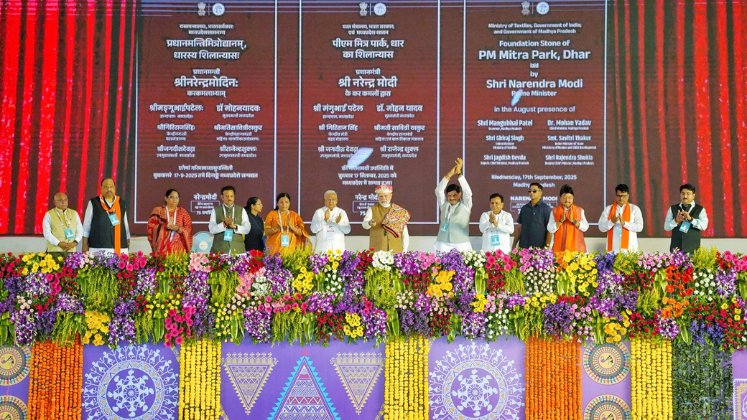
Prime Minister Narendra Modi on Wednesday laid the foundation stone of the country’s first Pradhan Mantri Mega Integrated Textile Region and Apparel (PM MITRA) Park in Madhya Pradesh’s Dhar district.
In his inaugural address, the Prime Minister highlighted Madhya Pradesh’s rich Maheshwari textile tradition, noting that Devi Ahilyabai Holkar had given the Maheshwari saree a new identity. Recalling her 300th birth anniversary, he said her legacy is now being carried forward through the PM MITRA Park in Dhar.
He explained that the park will offer easy access to cotton and silk, streamline quality checks, and improve market connectivity. With spinning, designing, processing, and exports all under one roof, the entire textile value chain will be integrated at a single location. The Prime Minister reiterated the government’s 5F vision—Farm to Fibre, Fibre to Factory, Factory to Fashion, and Fashion to Foreign—to ensure a faster journey from production to global markets.
Spread across 1,300 acres with over 80 industrial units already allotted, the Dhar PM MITRA Park will see infrastructure and factory construction proceed in parallel. It is expected to create three lakh jobs while cutting logistics and manufacturing costs, making Indian textiles more affordable and globally competitive. Congratulating the people of Madhya Pradesh, he also announced plans for six more PM MITRA Parks nationwide.
According to a government statement, the PM MITRA scheme has been launched to establish large-scale textile manufacturing hubs with world-class infrastructure and facilities in seven states: Madhya Pradesh, Telangana, Gujarat, Karnataka, Uttar Pradesh and Maharashtra.
The Madhya Pradesh park is being developed on around 2,158 acres in Bhainsola village, Dhar district. It will feature a 20 million litres per day (MLD) common effluent treatment plant, a 10 megavolt-amperes (MVA) solar power plant, continuous water and electricity supply, modern road networks and 81 plug-and-play units.
Officials said the park will particularly benefit cotton producers while also ensuring sustainability and modernisation of the textile industry. Housing and social infrastructure for workers, including facilities for women employees, are being planned to transform the site into a full-fledged industrial township.