Apparel manufacturing, with all its inherent and situational complexities, has gone through a really difficult time over the period of a year. However, as pandemic blues are signing off, businesses are showing signs of revival. Dried up cash flow, cancelled expansion plans, migration of workers, trimmed salaries and low order volumes are being reversed and adding to the delight of the factory owners. Progressive factories studied the market sentiments when business was stagnant and took the opportunity to lay out plans for 2021 onwards so as to re-start business activities with a new zeal. The factories have timely realised the importance of ‘process visibility’ that’s a key parameter for any organisation to cut down on both tangible and intangible costs through cutting edge innovations and technologies.
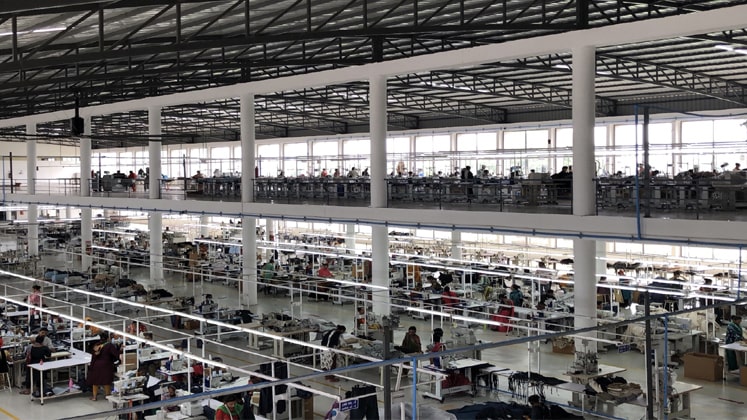
One such factory is India’s Ahmedabad(Gujarat)-based Zedex Clothing Pvt. Ltd. that’s sailed through tough time and is now ready to accelerate its business with a clearly defined organisational goal to which each and every member is perfectly aligned. The company runs three woven clothing factories in and around Ahmedabad that has a collective area of around 200,000 square feet and produces premium quality of menswear and womenswear products. Zedex is a pioneer in using all sort of automation, including over 1,000 UBT and high-end sewing machines, within factory premises to produce nearly 400,000 garments per month for both domestic and export markets, clocking over US $ 12 million of annual turnover.
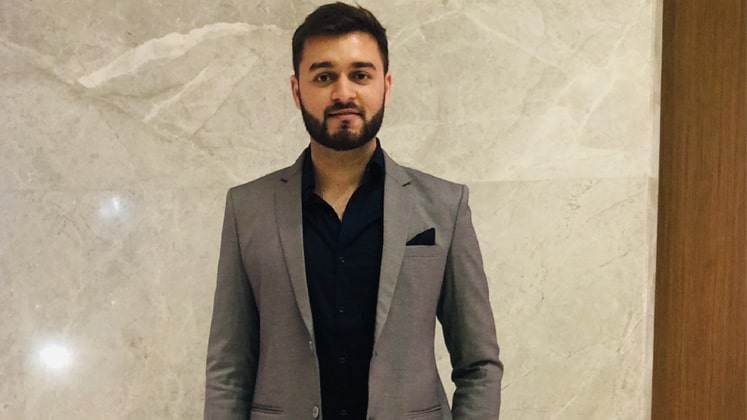
Team Apparel Resources approached Dhwanit Gohel, Director of Zedex Clothing who is a young and dynamic second-gen business leader and touched upon issues that are worth talking about in a changing business landscape. Here are exceprts of the exclusive conversation.
AR: How has the market been over the last one year for Zedex Clothing? How have you been financially managing your workforce amid massive economic distress due to COVID-19?
Dhwanit: Well honestly, it has not been very easy. Like everyone, we faced order cancellations, deffered deliveries and even discounts. From making PPE kits to masks, we have done it all just to ensure that our workforce has the support of work in order to sustain the times. Business was hit so we had to find different avenues to generate cashflows. We even supplied customised covers to a US-based customer to maintain factory activity. Initially, we had to trim the salaries but since last Diwali, it has been brought back to normal. Infact we have even offered increments to some of the team members. So overall it has been a journey of ups and downs; and now we are back on track.
AR: What has been your learning in this pandemic period?
Dhwanit: An organisation which is agile and adapts to changes can survive such disruptions. Also, there is always excess fat in an organisation which needs to be constantly monitored and due actions need to be taken solely keeping the company in mind. As the company grows, there are these small leakages which can affect profitability. Target should always be to increase efficiency for long-term business survival and that’s the best thing we as a team learned in all these months.
AR: Zedex is mainly into woven garment manufacturing…Woven clothing worldover has been in less demand during COVID-19 of late as people are preferring knitted products, while they WFH. Do you see any fluctuation in woven apparel demand from buyers’ side?
Dhwanit: We did observe changes in preferences getting inclined towards knits in the initial days of Covid outbreak but over time, woven as a category has seen revival in demand. Offices have restarted, people have started going out and travelling, These are the few reasons why woven is back in demand.
AR: Zedex works with domestic retail industry as well. What are the major differences that you see between working with overseas buyers and domestic buyers in today’s time in terms of product categories, pricing, compliance and technology?
Dhwanit: Every buyer has their own set of requirements. Be it compliance or technology, the final deciding parameter for order comes down to price. Factoring the subsidy benefits by state government and the investment in automation, we are really price competitive.
Quality is another major factor as today’s customer has become very aware and conscious of the product he is buying. Buyers are now looking for environment-friendly factories. Several brands have started sourcing more than 50 per cent of their range from such units. Compliance is non-negotiable. Now apart from Sedex & ISO requirements, brands have their own set of compliance norms as well.
AR: Can you name some retailers (domestic ones too) who are particular about sourcing from environment-friendly factories? Who are the certifying bodies/certification marks that are recognised by domestic retailers? Also, are there retailers who have their own norms?
Dhwanit: Landmark Group’s Max is very particular about sourcing from environment-friendly factories as they mentioned about close to 50 per cent of their sourcing of current season being from eco-friendly factories – factories that are working on less water wastage. Also, Reliance has a separate range of eco-friendly denims in which the fabrics used are made with significantly lesser water usage and chemical treatment.
As far as certifying bodies are concerned, Intertek and TUV are there in the market among others that are recognised by the domestic retailers.
ABFRL (Madura Brands in particular) does have its own set of compliance requirements and code of conduct to comply with.
AR: We could see you have invested in some automated solutions lately. What inspired you to plan and execute such expansion during COVID-19 time?
Dhwanit: The supply cycle of apparels has always been very long. Brands planning for their range a year later, manufacturers planning for deliveries 6-8 months later. In these times of fast fashion, it is inevitable to shorten our lead times. We saw technology as an opportunity to bring down our lead time. With the help of current automation like auto spreader, auto cutter, pocket setters etc., we have been able to achieve smaller cycles and turnaround within 3 days from cutting to stitching outward. Also with many national and international brands expanding their retail footprints in India, they will always need good compliant manufacturers who match their quality requirements.

AR: How are technologies helping you keep processes simplified and reduce costs particularly in cutting room and on sewing floor? Please share a couple of examples.
Dhwanit: Yes, we have invested largely into automation but after a thorough research and meetings with several suppliers as well as visiting factories and machinery expos in China. It is very important to assess options as there could be huge price variation and can significantly affect the total investment.
Instead of 4-5 people staying involved in layering and cutting process, now it takes only 2 people as we use auto-cutting machines: from loading the fabric rolls to supervision of cutting process. The chances of error are as good as negligible due to the accuracy of these machines. The output in manual cutting could be 2000 pieces per day whereas it’s 4000 pieces per day on automatic cutter. More than fabric wastage, it is about the efficiency and accuracy of cutting.
As the installed auto-cutters are fitted with IoT solution, it does help us with real-time cutting data. With the kind of software solutions we are exploring right now, it enables us to have the entire data of cut to pack processes, from line issue to mid-line and end line audits, defect heatmaps, DHU, Efficiency% and production outputs all in real time.
Further, a machine operator could attach 150-200 pieces per day if they have to crease and attach pocket whereas in a pocket setter, the output goes up to 800+ pieces per day. It typically takes less than 3 seconds for pocket hemming on automatic machines whereas an operator takes about 15 seconds to crease and hem. Also, a pocket is attached in less than 30 seconds on a pocket setter including creasing and attaching, which in turn takes about 2:30 – 3 minutes for a skilled operator for both processes.
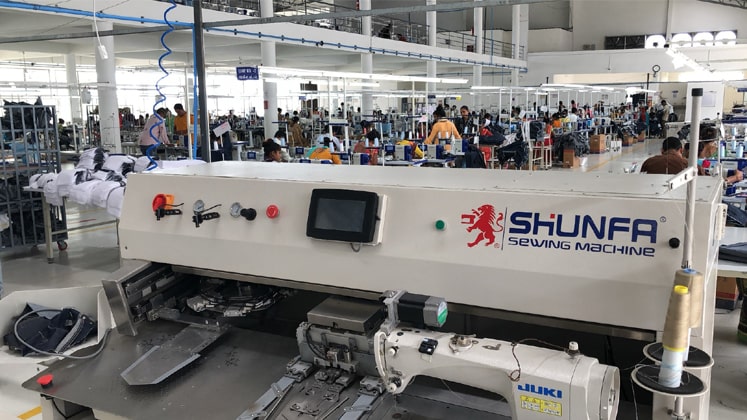
Back pocket welt and pocket finish require a highly skilled worker, who at the best efficiency could finish 200 pockets. We have installed automatic pocket welt machine which does not require a skilled operator and can easily clear 600-700 pieces per day at a consistent quality.
We have observed line outputs on the same evening or maximum next day first half for many of our lots, considering all of this automation it is possible to dispatch styles within 15 days as well.
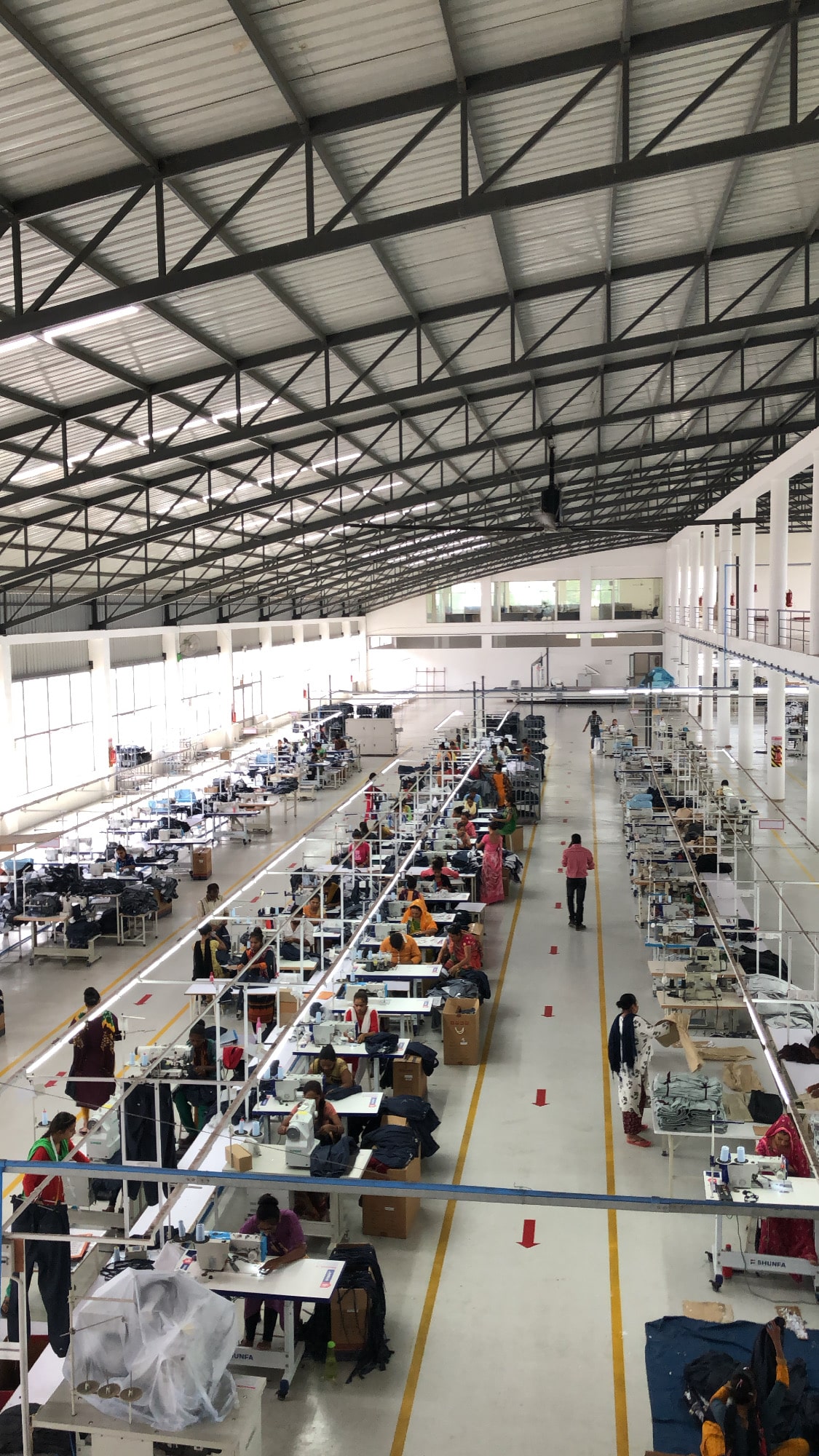
Because of such assembly lines, we have been able to achieve a line output of over 900 pieces per day with more than 70 per cent workforce that is freshly trained.
We have just installed Timtas hanger system and haven’t started using yet. Hanger systems haven’t found much space in Indian apparel manufacturing landscape but is gaining momentum now due to the perceived benefits. Lead times are significantly lower and we get real time data of the machine wise output as all the stations and hangers are linked with RFID.
Also, we have had inhouse washing unit since over 15 years. Next project for us is to set up a ZLD ( zero liquid discharge )/eco-friendly laundry set-up for decrease water usage and pollution control.
AR: Are you also planning to go for real-time monitoring of your factory processes using IoT on sewing floor?
Dhwanit: Well that’s the way forward, we’re exploring processes and technologies in that domain currently which collect real time data and help not just monitor processes but reduce defects. Till the time we go for IoT, the installed ERP is being used to the optimum level.
The biggest benefit of ERP has been real time data of line outputs and production maping –from OCR to inventory control.
AR: As automation is gradually taking over the manual operations even in a labour intensive countries like India, can this be an issue in future in terms of manpower disruption?
Dhawnit: Automation will prove more of an enabler than disruptor. Every manufacturer should embrace technology rather than running away from it. To be able to compete globally, we will have to adapt automation. It will be a challenge definitely but we need to constantly upscale and upskill our workforce. Apparel manufacturing has always been a labour intensive industry and one of the highest employment generators against the capital invested.

AR: Are you upskilling your existing workforce as well? If yes, what are training parameters?
Dhwanit: Our new setup is in the outskirts of the city where there isn’t a single apparel manufacturing factory. We have a full time training centre within the premise wherein at a time atleast 25 workers are getting trained. There are different modules of training from 2 – 4 weeks wherein we have bifurcated the trainees basis 3 categories –
- Completely fresher: who has never operated a stitching machine
- Intermeditate: who has operated machine at home / has basic know how of stitching
- Trained: who has worked in apparel factory but for any other operation. They can be easily upskilled and be shifted to specialized operations.
AR: Zedex has its own clothing brand BlueBuddha… How is it faring in the market? How big it is in terms of stores/e-commerce operations? And, what are consumers expecting from BlueBuddha in terms of products and pricing?
Dhwanit: Blue Buddha is the retail arm of Zedex Clothing, eshtablised in 2008 with 12 stores. It has gradually grown to 125+ stores chain across 7 states and targeted 150 stores in this fiscal. Our motto has been to provide fashion at smart pricing. Blue Buddha is available online only through the brand website.
We aim to make Blue Buddha a complete lifestyle brand for Men’s with not only apparels but also providing a great range of accessories. Recently we introduced socks, belts, wallets, boxers and fragrances which has a great response from customers because of the value price offerings.
AR: Moving forward, what are the biggest changes/challenges that you envisage in the fashion value chain?
Dhwanit: The biggest change we see is faster delivery turnaround and the drive for value fashion. Customers expect to have the garments in their wardrobes as soon as some celebrity / influencer wears it. The trends are changing faster than we anticipate. Most of the retailers currently expanding are in the value format categories compared to medium priced & premium brands. Needless to say, price will be one of biggest factor that will playout for fashion value chain.
Also due to a great influence of social media and influencers marketing, niche brands and those selling curated content will see a greater growth in the digital space. Community selling and social commerce will be the next thing.
AR: What are your future plans – expansion, turnover, product diversification?
Dhwanit: In the last 1 year, we have nearly tripled our manufacturing capacities from 1.25 lakh pc to about 4 lakh pcs per month. We plan to enter the digital space with a separate brand which is getting planned currently. With the help of technology it is imperative that we expand even further and be amongst the top apparel manufacturer in India catering to domestic as well as export market.
Why Gujarat is a go-to state for manufacturing companies?
As Zedex Clothing has expanded significantly off late and became one of the fastest growing apparel manufacturing companies in the Western India, the credit goes to state policies as well. Essentially, new-age entrepreneurship with Government support in form of various subsidies are collectively working as a catalyst for the state’s apparel manufacturing business and one can create the most cost-effective manufacturing infrastructure here. The factory has collaborated with a renowned apparel manufacturing business consultant Nimish Dave, Founder, The Idea Smith to set-up the new unit and Nimish is in praise for what Gujarat has to offer as a Manufacturing Destination:
1) 50 per cent subsidy on building construction.
2) Rs. 4000 per woman worker subsidy per month, which is Rs. 3200 in case of a man worker…The good thing is these subsidies are still continuing in Gujarat post-pandemic unlike many other Indian states!
3) Term loan at 5 per cent per annum
4) Attractive land prices, far better than neighbouring states like Maharashtra
5) Abundant worker availability
6) Well established Textile and Apparel eco-system
7) Peaceful industrial environment
8) Supportive administration and Government
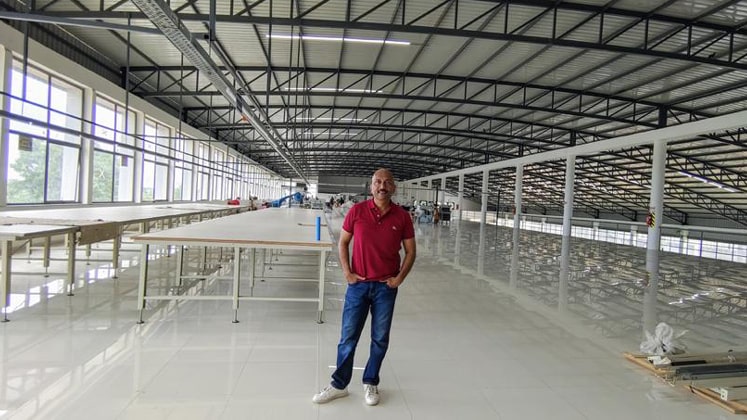
*Why we are saying Gujarat is a cost-effective state for manufacturing business is because comparative analysis says so. Team AR would be glad to further elaborate and share actual data and facts of manufacturing destinations of outside India, as well as various states within India…Stay connected!