Pandemic has given a boost to e-commerce fashion business. As more and more fashion shoppers are going online, more is the need felt by brands to engage them in a better way and enhance their experience of online shopping. However, due to ever-evolving consumer preferences, online experience isn’t as simple as it may seem, especially for brands that have a large number of products in their offering. Too many products, coupled with large number of fashion shoppers looking for something very specific, becomes a hard-to-manage event and, for that to be effective, brands need a good and error-free catalogue management system.
For an online shopper, the simplest way to locate and identify a product on an e-commerce portal or marketplace is a simple text search. More often than not, it happens with fashion consumers searching for a product, let’s say joggers, on the online portal of a brand that they see more products other than joggers in their search queries. The major reason behind this is inconsistent and unstructured tagging of product descriptions and facets that lead to broken textual searches on the site or app and impede product discoverability for both retailers and shoppers. A lot of useful search results also get excluded from this process. However, the same can be rectified with the use of automatic product tagging technology that uses AI-based image recognition system to identify exact products that a shopper searches for!
What is ‘Automatic Product Tagging’?
Automatic product tagging is a process that eliminates manual fashion product tagging, organises and tags photos in the product catalogue based on their characteristics, leveraging advanced Artificial Intelligence (AI) algorithms. These algorithms speed up the fashion tagging process making it automated and eliminating the need for human intervention. Simply put, this automatic product tagging is a process that generates rich metadata for catalogue assets.
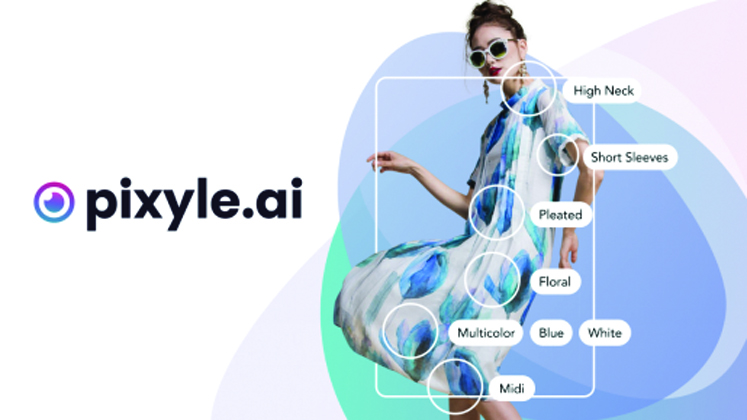
Pixyle.ai – A Dutch technology company pioneering in automatic product tagging
A product catalogue is a place where all the online retailers’ products are precisely ordered. Catalogue management is a process that organises the products in a catalogue in a specific way in order to make them consistent and relevant. The optimisation and modification of product data are also included here. As a standard process, the catalogue should provide information such as product’s names, categories, price, brand, colour, suppliers and other relevant information. These tag categories need to be accurately ordered to make it easy for customers to find the right product.
“Unfortunately, brands and retailers have been using human workforce to fill this information manually since the beginning which otherwise could have been used for value-added jobs. Pixyle.ai’s technology eliminates this manual job and enhances product searches on e-commerce,” commented Svetlana Kordumova, CEO, Pixyle while talking to Team Apparel Resources.
Searching is often the first thing website/app visitors do when they come to a fashion e-commerce platform. If the information attached to the products is incorrect, the search engine will display the wrong results. Displaying the wrong results can make the visitor leave immediately. Since customers often aren’t very precise in their searches, the search engine has to be very smart in order to find what they really mean.

“The process of AI system of Pixyle works in a way that it scans the image and detects features that are connected to particular keywords” Svetlana Kordumova CEO, Pixyle
Incorrect search results have led to more returns, since what people found and ordered might be different from the tagged data associated with it. And this aspect of online shopping experience has to be well managed because, according to Shopify, the search tool can generate up to 13.8 per cent of an e-commerce store revenue.
Svetlana explained, “The process of AI system of Pixyle works in a way that it scans the image and detects features that are connected to particular keywords.”
Automatic tagging is a trained AI system that can recognise clothing in images as humans do. For humans, it takes only a glimpse of an image to recognise a clothing item to decide what it is – a dress, a blouse or jeans. For computer, this is not an easy task as it understands only in pixels and that is why a large part of inventory management is done by humans. Pixyle addresses this core issue.
With the advancements of Computer Vision and Deep Learning, Neural Networks have been created that mimic the human brain and can be trained to recognise what is there in an image. These neural networks can take an image, process it and give humans semantic information in the form of text. “The accuracy rate of our technology is over 93 per cent. It can automatically tag more than 336,000 images in a day that is over a hundred times more than a human can,” said Svetlana.
A trained AI system that has seen thousands of fashion images, carefully tagged. Now, it can do the same – perform fashion tagging with various categories and attributes. During the automatic tagging process, the deep learning algorithm processes the pixel content of visuals, like images or videos, extracts their characteristics and discovers relevant objects. An automatic fashion product tagging model can increase catalogue processing time by up to 90 per cent.
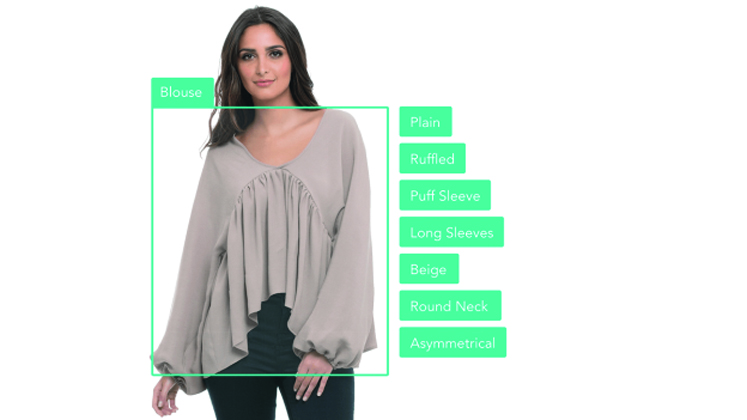
Products don’t have only one tag. In fact, they can have many different fashion tags, as mentioned by Svetlana. For example, an image of a beige blouse (Image 1 shown below) can have several fashion tags attached by the machine learning technology – beige blouse, plain blouse, slim-fit, long-sleeve, puff sleeve, round neck blouse, etc. Even though the shopper might only remember to look for a blue shirt, the AI technology takes all product descriptions and feature specifications into consideration. This allows people who are looking for a blue shirt or a slim-fit shirt to find the same shirt in the product catalogue.
Pixyle technology is beneficial for online retailers and consumers in many ways such as less time consumption of shoppers, improvement in catalogue management for retailers, reduction in shopping cart abandonment rate, better search engine ranking, increment in consumer spending and accurate predictive analytics.
VueTag – Assisting fashion retailers enhance visibility of their products on e-commerce
Vue.ai – an innovative AI-driven branch (brand) of Indian technology company Mad Street Den – has come up with VueTag that uses image recognition to extract attributes like category, gender, colour, pattern, dress length, sleeve length, neckline among others. Using the power of AI, VueTag’s algorithms are trained using thousands of images to identify the visual attributes and are completely automated to a level that does not require much manual intervention, saving significant time and resources both for fashion brands and consumers.
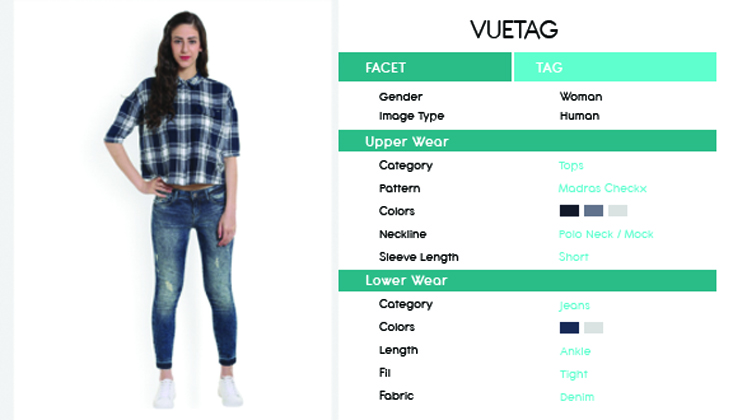
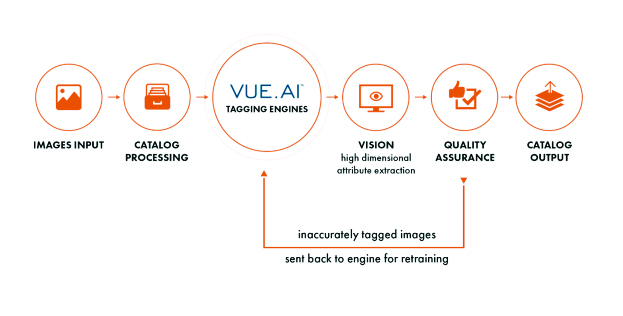
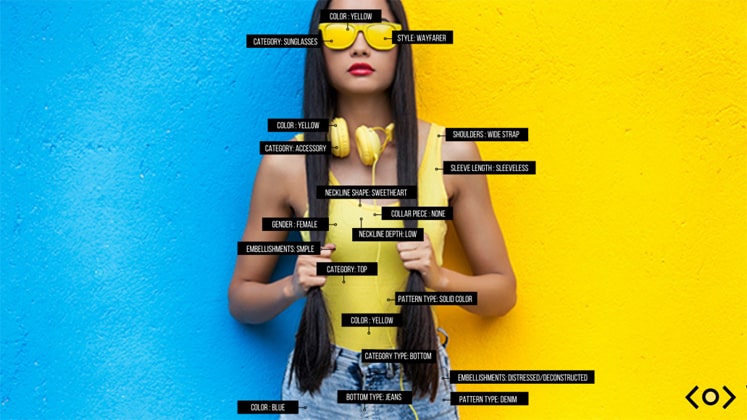
The process starts with sending the catalogue to its engine in various formats. The catalogue images that are received in various formats – as User Generated Content (UGC), social media feed, low-quality images and more, are then processed through VueTag’s engine, where regions of interest are drawn like in the image below. These identify attributes like category, gender, colour, pattern, sleeve length, necklines, silhouette and more.
Taking it one step further, in order to figure out certain non-visual attributes such as fabric or occasion/style, VueTag’s NLP systems detect these facets based on textual information.
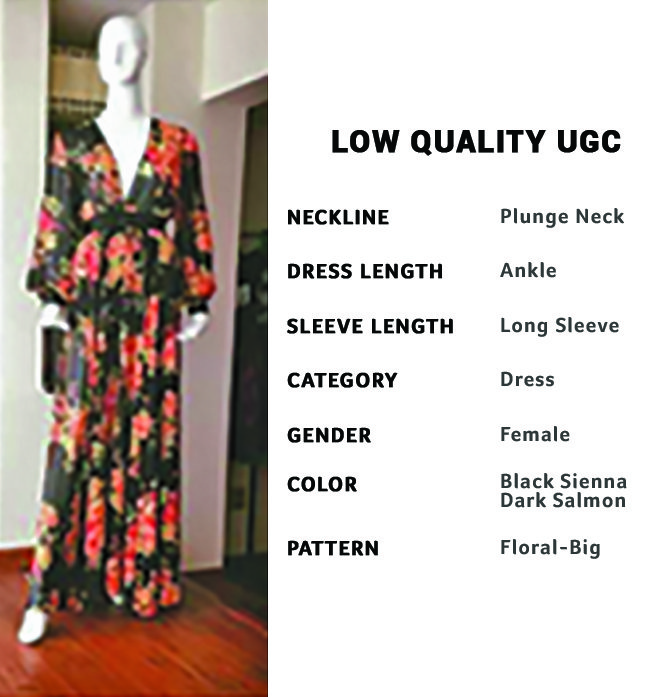
As shown in Image 2, the VueTag engines are trained with all sorts of imagery and are designed to accurately extract visual attributes, which go beyond just the categories. The engines also have a level of flexibility wherein they have the capability of adding new tags as required for various types of catalogues. Once the tags have been extracted, a round of QA is performed. Images that have been inaccurately tagged are sent back into the system for retraining. The tagged images are then delivered for the enrichment of the catalogue and for the optimisation of product discovery.
Source: Vue.ai
“Vue.ai’s computer vision powered auto-tagging machines are trained continuously to learn the various attributes from training imagery that are unstructured, replicating what is usually found in marketplaces,” told Vue in a statement.
Case Study – Diesel opts for VueTag
Diesel, a globally renowned lifestyle brand, is part of one of the biggest European luxury fashion groups – OTB. Known for redefining luxurywear, the brand is known for pushing denim into the premium category. It is one of the biggest brands within OTB, generating about US $ 1 billion in revenue in 2020 alone. Diesel started using Vue.ai’s AI-powered automated product tagging solution in 2020.
Challenge faced by Diesel
New products coming in every season needed to be sorted, styled, photographed and then sent to the team for attributes to be tagged manually. The process threw up three critical issues:
Slow onboarding time: More than a week was spent waiting for all the images from a shoot to be uploaded before it could be tagged – meaning a longer and delayed go-to-market period.
High time and effort with manual tagging: It took multiple resources over a week to tag and process the images each season.
Inconsistency in catalogue: The tags and attributes coming in for products from different sources were not standardised.
To solve these issues, Diesel needed a tool that could – automate the tagging process, while being capable of integrating with its existing PIM tool; recognise and specifically call out whether certain iconic logos are present in the products; standardise the values and attributes for use across the organisation; and streamline the entire process end-to-end, saving time.
Solutions given by VueTag
Automated tagging: Faster product onboarding
Automated product tagging helped Diesel tag products in a fraction of time compared to what it took to manually tag products. AI tagging has been shown to improve catalogue processing time by up to 90 per cent. Instant tagging was implemented for Diesel with the aim of being able to get its products to market faster.
AI-powered tagging – scalable process
Tags extracted by the tool primarily helped Diesel enrich its catalogue data. Some of the downstream benefits included powering filters on the website to assist user journeys, enriching catalogues from other vendors and the ability to use the extracted tags for analysis and forecasting.
Standardised tags – clean, consistent catalogues
Standardising data across the catalogue is essential for unifying the shopper experience across channels. VueTag generates tags with standardised information- reconciling and generating content in the process.
The Impact:
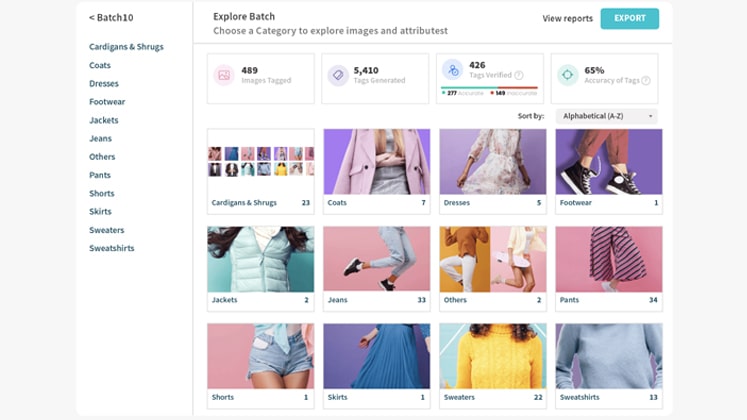
A total number of 18,000 images have been tagged on Diesel’s online portal, 22,300 tags have been generated and 130 batches have been uploaded.