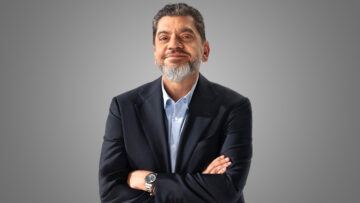
Sara Textiles, (part of the diversified Sara Group) founded by D P Singh, a Noida-based home furnishing exporter handling an export business of Rs. 225 crore, is smoothly developing with 15 to 20 per cent growth every year and is even further geared up for 35 per cent more growth. S M Dwivedi, CEO of the company, who is associated with the organization from day one and started here as a QC Manager, explains how he managed this growth and why he is confident about the future. Having given 24 valuable years to this company, he strongly believes that the textile industry can be managed through professionals without the day-to-day involvement of promoters. In an interview with Apparel Resources, he discussed about his experiences and business learnings that he has adopted throughout his journey so far.
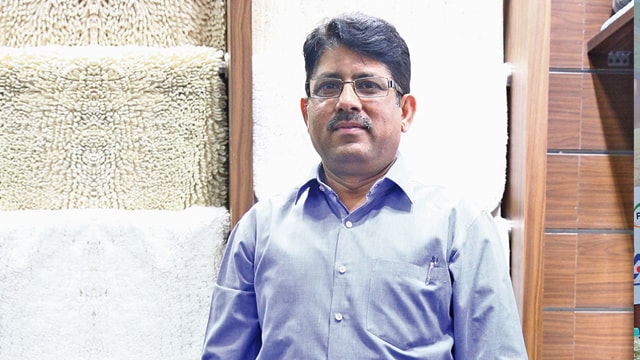
With an initial start as a buying house, and then growing as a trading company to becoming more than a decade-old leading manufacturer of towels, Sara Textiles is almost a debt-free company having more than 100 buyers and exporting to more than 40 countries. Apart from a major share in Europe and prestigious clients like Lidl, Germany, the company is also associated with many dotcom companies in US and hotel industry in many countries. “We never leave any of our customers, be it big or small, and no major customer has left us so far. Whenever we expand, we look at the new markets and our capacity dedicated to the existing customers remains untouched,” says S M Dwivedi. He further adds that every difficult time that they have undergone has been a learning for the company and the entire team has managed the crisis successfully every time with the support of its vendors. This has ensured the smooth running of the organization so far. A positive Dwivedi avers further,“Whatever and whenever we have faced challenging times, due to recent policy changes or otherwise, we have evolved being more innovative in designing, costing and market developments and have enhanced our focus on the services. All this in a collaborative manner would deliver much better results in the coming years. We are managing our inventories quite precisely with thin manufacturing process, and now we are into the peak season getting lot of orders from Europe and other countries also. We are even fully booked till the last quarter of this calendar year.” Insisting on the current business environment, he strongly believes that the industry is very close to its good time but this proximity will be defined by how proficiently the Government machineries perform. All the decisions taken by the Government should have a very positive impact on the entire economy, specially on those actively involved in export business.
Refund issue
Long pending refunds should be released immediately as the industry is now already suffering from working capital blockage. We have over Rs. 3 crore refund fromTUFS scheme and nearly Rs. 4 crore of drawback duty with the Government.
Although ‘towels’ remain its central goal, the company is now targeting growth in polyester blends and is very upbeat about it. Dwivedi briefs that earlier India was strong enough in cotton polyester towels, especially since these were very suitable product categories for the hotel industry as well as financially cost-effective too. Hence, blends would now assure bigger business in this existing set-up with some extra efforts. Even more transparency and increased competitiveness due to revised policies are motivating the company to increase its blend of synthetics. “Cotton will remain India’s strength and it will grow side by side at a natural rate. I am talking about raising India’s market share in the world economy not in terms of a small percentage but a manifold leap in turnover and that is possible by more use of polyester. Both cotton and synthetics would go together. Earlier it was only one (cotton), but now it is 1+1 (cotton and polyester). There is a big opportunity now in the MMF sector,” he added.
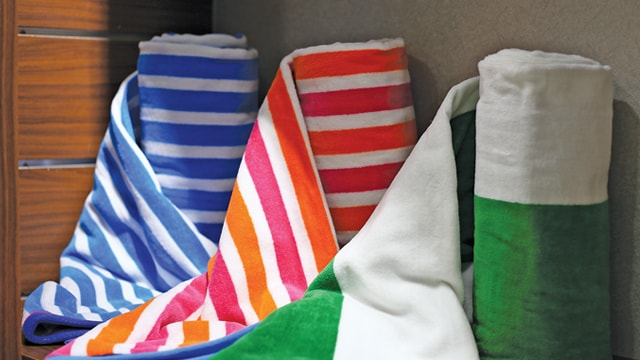
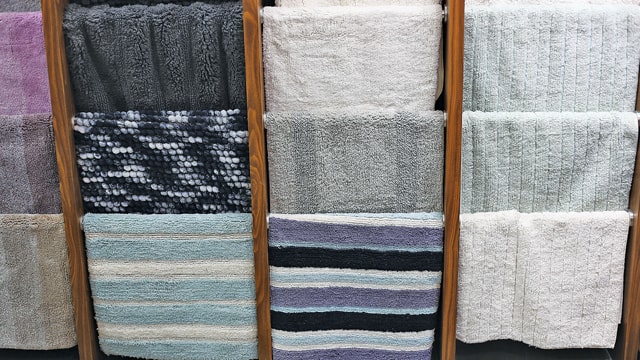
On the other hand, Sara Textiles has managed bottom lines by adding more and new products since it has realized that it cannot expand in towels as much as other Indian towel giants. Keeping the organization capable enough to survive and growing products like bath robes, bath mates, shaver curtains and fitted sheets (jersey) constitute the organization’s key strategies. It would even be expanding soon in knitting.
Professionals can run industry very well without…
Strong mutual trust, promoters’ vision, support and guidance, continuous challenge and freedom to execute ideas are some of the pivotal reasons why SM Dwivedi is with the organization from last two-and-a-half decades. “I purchased land and all the machines for the company, got them constructed at the plant, deployed a workforce of more than 1000 people, developed a senior team, paid nearly all the loans to the banks and I am still continuing and all this was possible due to the above mentioned factors. So if one gives opportunities to professionals to take up new challenges, giving them mental growth, they will be naturally doing their best for the organization, spending long time with it,” says Dwivedi. He further adds that the policies of the promoters, how they want to run the show, how they want to use their time and capabilities in controlling day-to-day operations, and how willing they are to divert their own capabilities in forecasting, ascertain an organization’s chances of growth. He strongly reasons that promoters should involve themselves more in the vision of the company and give ample space to professionals to handle everyday operations to boost an organization to grow holistically.
Similarly, a professional can’t be an entrepreneur, especially in case of risk-taking abilities for financing the business. Professionals should know how to deliver and how to execute the vision of the promoters. “I can proudly say that my management trusts me on that level and that is why we grew in this way. In our everyday functioning, there is no role of promoters. They give us guidance, suggestions and help us in vision formation and we are happily growing,” he asserts.
Himachal still priority
Having manufacturing unit in Nalagarh (Himachal), the company is happy with the state because of initial subsidies, better power supply, better air connectivity, proximity to Inland Container Depot Ludhiana for sourcing of raw materials and support of the State Government. “We got offers from other states but still we will prefer Himachal for any further expansion as we have easy and direct access to concerned ministers and top bureaucrats,” says Dwivedi.
Group support to individual company
Sara Group is a diversified group which is into mining, textile, garment machinery (Magnum Resources) and trading of commodities. As per the policy of the Group, every company has to develop its own strengths, resources to survive but Dwivedi highlights that when one is part of a big group, there is an unspoken, unwritten confidence that Group companies will help them when they are in trouble. “Secondly,” he confirms, “the most important factor is knowledge sharing as through our associate Magnum Resources, we get various valuable inputs (without sharing exact detail) about the current situation, industry trends… It helps to identify a direction. Apart from these, some regular routine support is always there. We have a policy that every Group company should expand, and grow by its own resources.”



 Bharat Tex Special Report 2026