On a cold winter morning, in 1995, at the Bobbin International Exhibition arena in Atlanta, (USA), the first apparel consultancy company of India was initiated when the legendry KSA set its foot in India through Technopak. Initial consultants of KSA Technopak were regularly sent to premier technology exhibitions like Bobbin Show, Atlanta and IMB, Cologne to acquaint themselves with the latest technologies in apparel manufacturing. More than 20 years hence, management consultancy is now a big business in Indian sub-continent and South-East Asia; there are both large organisations as well as people-oriented small ones involved in the business. Everyone has their niche market, but technology has vanished from everyone’s radar; it’s only management which is left. Today most of the consultants from these organisations are management persons. Dr. Prabir Jana, Professor, NIFT Delhi takes a closer look at the scenario today.
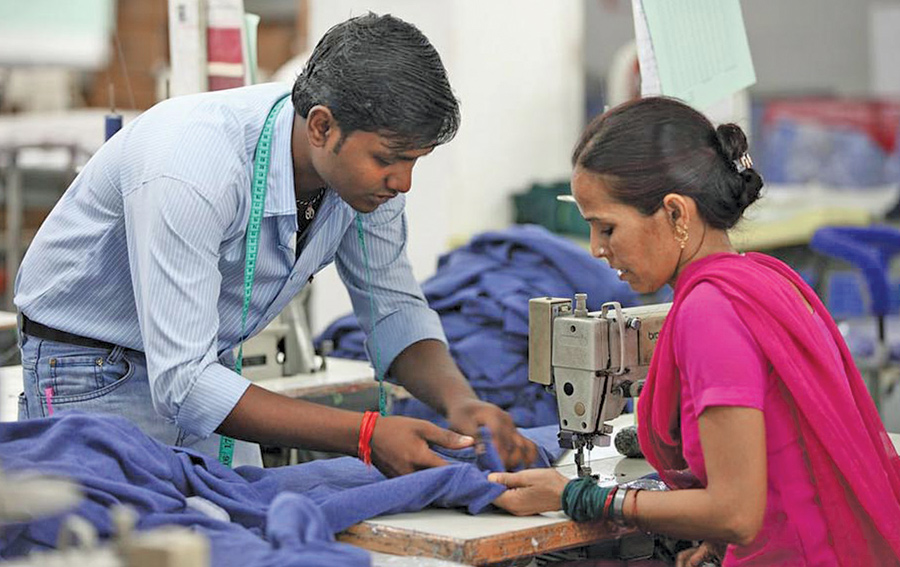
If we see the job roles of managers in apparel manufacturing organisations in Indian sub-continent and South-East Asian regions, there are general managers, production managers, industrial engineers (if any) and quality managers. Under these, there are executives and supervisors managing the workforce at the bottom of the pyramid. Earlier (when IE was not popular) in large manufacturing organizations there was a position of ‘technical manager’, who used to look after the technical aspects of the business, similar (although not exactly) to the current job roles of IE, limited to the requirements of the organization.
Like all other job roles, the role of a technical manager has also evolved from being reactive to proactive; from problem solving approach to problem arresting/avoiding approach, and gradually the new designation and whole new meaning was born through industrial engineering.
It would be wrong to assume that before IE became popular, work study was not practiced in the factories. Rather to my understanding probably work study was done with more rigor earlier than now; only work study persons were working under the production manager unlike industrial engineers now.
What are the technology job roles in an apparel manufacturing setup…? Identification, selection and procurement of appropriate machinery, equipment and consumables for all operations, proper maintenance of these machineries and utilities for maximizing the uptime, and garment engineering for better fit and cost optimization, are the main areas of activity. The most important roles of selection of manufacturing system, allocation of manpower, and dynamic balancing of resources were initially the responsibilities of production manager, who may not have any knowledge about machineries.
Identification, selection and procurement of appropriate machinery and equipment
To disburse this role, the person should have thorough knowledge about all pre-sewing, sewing and post-sewing machineries; different features offered by different brands and models, he/she needs to constantly update himself/herself with the new launches of technology. The person should be able to map the machine’s features with style requirement, so that he/she can identify the right feature in a machine based on the style feature that is required to be produced.

A machine engineer may know all the features/capabilities of the machine, but may not be able to map the machine’s features with style features. A technical manager should be able to bridge this gap; for example, suppose a polo T-shirt style of pique fabric with viscose blend is going in to production. The technical manager should be able to foresee the problem of distorted buttonhole in placket and thus the requirement of buttonhole machine with reinforcement pre-tacking (basting) feature.
Let’s take another example; garment to be manufactured is men’s casual shirt with double needle top stitching (1/4th inches gauge) at collar, cuff, yoke, shoulder, and pocket attach. Top stitch at collar, cuff and pocket attach will require pivoting at corners while fixed needle bar is suitable for topstitch at yoke and shoulder, and therefore some of the double-needle machines should have an “organized split needle bar”. The blending of fabric characteristics with garment construction and machine features is the value the technical manager delivers. After identification of machine features, which is mandatory, the short listing of brands and models needs to be done, followed by selection and procurement based on least total cost of ownership (TCO) which is the key to effective management.
However, we need to appreciate the fact that identification, selection and procurement of machinery is generally a one-time activity during plant set up and not required on a day-to-day basis. Therefore, this role is generally outsourced and factory does not need to employ full-time in-house expertise for the same.
An organization can engage any machine supplier to suggest the list of machineries based on product type, and all machine suppliers happily do such exercise to secure the order. Getting the same exercise done from multiple machine suppliers, and analysing and comparing all, a factory generally decides on right set of machinery and equipment. Although, in number of cases such selection is wrong, because once the mandate of selection is given to machine supplier, the stock models/higher commission models are suggested on priority rather than technically correct models. As the factory may not have in-house technical expertise, such mistakes go unnoticed. In short, a factory can do away with this job role.
Identification, selection and procurement of consumables
Selection of right needle point type and size is very important for quality and productivity and again requires updated knowledge of what is being offered by leading brands and how such features map against different style requirements. Obviously an in-house technical manager can’t keep himself/herself updated with all possible latest offerings from different needle and thread manufacturers. With aggressive customer service from leading needle and thread manufacturers/suppliers, factories outsourced the selection of right needle and thread way back in the mid-90s. Today it is common for a large needle, thread and interlining manufacturers/suppliers to collect fabric swatches from garment manufacturers, do R&D in their own laboratory and suggest the right specification of needle or thread or interlinings, completely free of cost. So, why does the garment manufacturer need this expertise anyway?
Maintenance of machinery, equipment and utilities to maximize the uptime
In most of the organizations maintenance has only one sub-type: breakdown maintenance. As preventive maintenance or the latest phenomenon “predictive maintenance” is still at infancy, the company feels this job role does not deserve more than a machine mechanic. With annual maintenance contract becoming popular due to the strength of core competency concept, there is no chance of having in-house expertise for this job role in near future.
Garment engineering for better fit and cost optimization
Pattern engineering or garment engineering is not common in factories in this part of the world, because both pattern making and garment construction are not prestigious job roles in the eyes of employees with typical naysayers thinking what’s so special in pattern or garment engineering? Just to reply to this query, how many of our pattern makers use step-seam allowances to reduce bulk and stripe matching during sewing? If we analyze maximum European expats working in this part of the world, they are actually garment technicians.
Then ultimately what is the technology job role left to be done by in-house experts…? None, actually. If we look at the management job roles – selection of manufacturing system, allocation of manpower, and dynamic balancing of resources, only last one is an eight-hour job, but in reality, a manager is always busy because there is always ‘firefighting’ on production floor! Unlike the technology job roles, which are one-time requirement for a style, management job roles are an all-time demand. Even if we buy the argument of outsourcing the core competency, where is the core competency in technology? The popular consultancy organisations are offering merely management consultancy…, where are the technology consultancy firms? Does this mean that management job role is mandatory while a garment manufacturing organization can run without the above mentioned technical expertise? Answer is deep-rooted; it is the erosion of perceived value of technology in people’s mind.
Over the time, management philosophies have evolved with newer jargons, continuously attracted young minds and baffled the entrepreneurs (thus the never-ending requirement of management expertise). Two decades ago, ISO 9000 was a big business; one decade ago SPC was the flavour amongst apparel buyers; and today it is Lean manufacturing. On the other hand, technology failed to re-invent itself to keep the interest alive.
Use of Lean tools like VSM, Kanban, 5S, SMED is in everyone’s radar. Out of many tools if one analyses, it is clear that tools that require management expertise are popular while the tools that require technological understanding are rarely implemented. Tools like Kaizen and Poka Yoke require deep understanding of the technology; thus organisations implementing them are limited. Also a deeper analysis of different tools will reveal that different tools are used to find same measure; for example, Yamazumi Chart and VSM both will tell you the share of your VA, NVA and NNVA. Exploration tools (management expertise) are many but improvement tools (technology expertise) are only few and difficult to master.
At the upcoming GTE show, apparel manufacturing technology will be exhibited, but every stall will have managers to promote and sell the technology, and there will be hardly anyone to explain the technology. It is high time manufacturing organisations recognize and encourage the technologists. The managers can identify the strengths of India but it is the technologists who will “Make” in India.




 Bharat Tex Special Report 2026